

Teacher of the Month
The Alabama Public Television Excellence in Education Award is a monthly recognition program for kindergarten through 12th Grade educators across the state of Alabama.
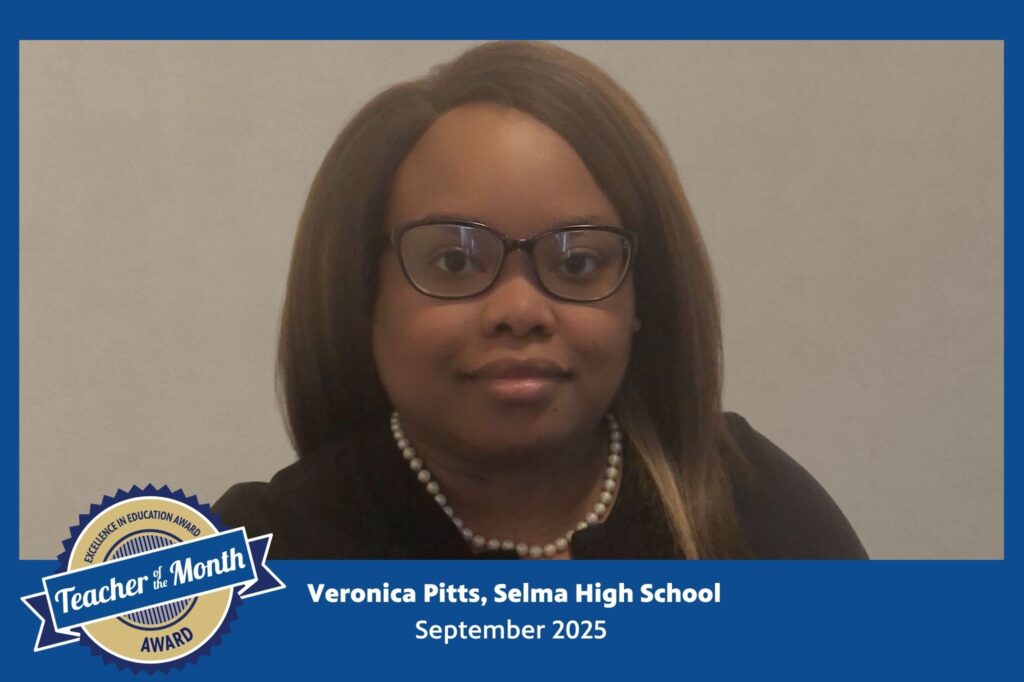
The bell rings and seniors slide into debate groups, policy briefs open, hydroponic plans tacked to the whiteboard. Veronica Pitts, a 12th-grade Social Studies teacher at Selma High School, guides the room with calm checks for evidence and voice. Twelve years in education, all twelve at her alma mater, she centers belonging and purpose in every conversation.
“I moved to Selma permanently in middle school, and at the time I absolutely hated history," Pitts says. "That all changed in 10th grade when I had a phenomenal teacher, Mr. Powell, who sadly passed away last February. He made the subject come alive and, more importantly, he taught us the importance of advocating for ourselves. I believe this is the perfect grade and content for me to help students before they enter the real world to become productive citizens.”
Her philosophy is clear: “I believe teaching should empower students to think critically, advocate for themselves, and connect classroom learning to real-world issues.”
In her classroom, learning looks like research, debate, and real decisions with real stakes.
“One misconception I love to bust is that Government and Economics are just about memorizing laws, branches, and supply-and-demand.” She adds, “I want them to see why their paycheck looks the way it does, how a city council decision affects their neighborhood, or why their vote carries power.”
Families and colleagues see it, too.
“Ms. Pitts is an outstanding teacher who doesn’t just teach government and economics," Eric Owens, a former student's parent, says.
Owens remembers a difficult season: “Ms. Pitts demonstrated extraordinary compassion and dedication when she helped my stepson and his class navigate the emotional and academic challenges he faced after losing a classmate to gun violence. Through her encouragement, he became involved in class projects…including participating in the SGA, where he developed leadership skills and a renewed sense of purpose.”
With APT’s $1,000 impact grant, Pitts will reintroduce hydroponic systems as a Government and Economics “living lab” for seniors this semester. Key purchases include 4–5 hydroponic kits, grow lights and timers, seeds and nutrient solutions, digital scales and measuring tools, plus student journals and display boards.
“The $1,000 APT grant will fund the reintroduction of hydroponic systems in my Government and Economics classroom, connecting students to real-world issues like food access, sustainability, and entrepreneurship,” Pitts says.
Collaborators include science, agriscience, and ELA colleagues, with Green Team and SGA officers serving as student leaders, and hoped-for support from Dallas County 4-H Cooperative Extension. Success is concrete and measurable.
“Students will create a policy brief or presentation connecting their hydroponics project to local food access, market dynamics, and sustainability, which will be scored for clarity, use of evidence, and application of classroom concepts," Pitts says. "Students will simulate market scenarios by adjusting production or distribution based on resource availability and community need, and their decisions will be evaluated for strategic thinking and use of economic concepts.”
APT’s Teacher of the Month pairs community recognition with a $1,000 classroom grant, a brief pre and post survey with artifacts, and opportunities to share on our podcast and blog. Today we celebrate Veronica Pitts and the everyday excellence her students experience.
“Never, ever be afraid to make some noise and get in good trouble," Pitts reminds her students, "necessary trouble.”




Follow Us