

Gov. Kay Ivey announced Tuesday that she will release $2 million of the state’s emergency funds to support food banks as Alabamians who receive federal food assistance miss their first benefit payments this week.
The governor’s announcement is a reversal from her earlier comments that the state would not step in to help support the Supplemental Nutrition Assistance Program, or SNAP, while the federal government is shut down.
The $2 million will go toward eight food banks in Alabama, which serve all of the state’s 67 counties.
“There are real Alabama families who rely on SNAP to put food on their tables, and that includes more than 300,000 children, more than 102,000 seniors and those who are disabled,” Ivey said in a statement.
“We are now in the longest federal government shutdown in history, and it is absolutely ridiculous that families all across our country are suffering – whether that is the school children who rely on SNAP, the air traffic controller not receiving a paycheck or even our military and high number of federal government worker families in Alabama.”
Roughly 752,000 Alabamians receive SNAP benefits that total about $140 million each month, according to the Alabama Department of Human Resources.
The food aid program, which is fully funded by the federal government, was suspended Saturday as a result of the shutdown. On Tuesday, White House Press Secretary Karoline Leavitt said the Trump administration will use contingency funds to partially pay for SNAP benefits after federal judges ordered the administration to do so. Leavitt’s reassurance came after President Donald Trump posted on Truth Social Tuesday that benefits would only be distributed “when the Radical Left Democrats open up government, which they can easily do, and not before!”
In Alabama, SNAP benefits are issued each month to recipients on specific days, beginning on the fourth of each month, Ivey’s office said in a press release.
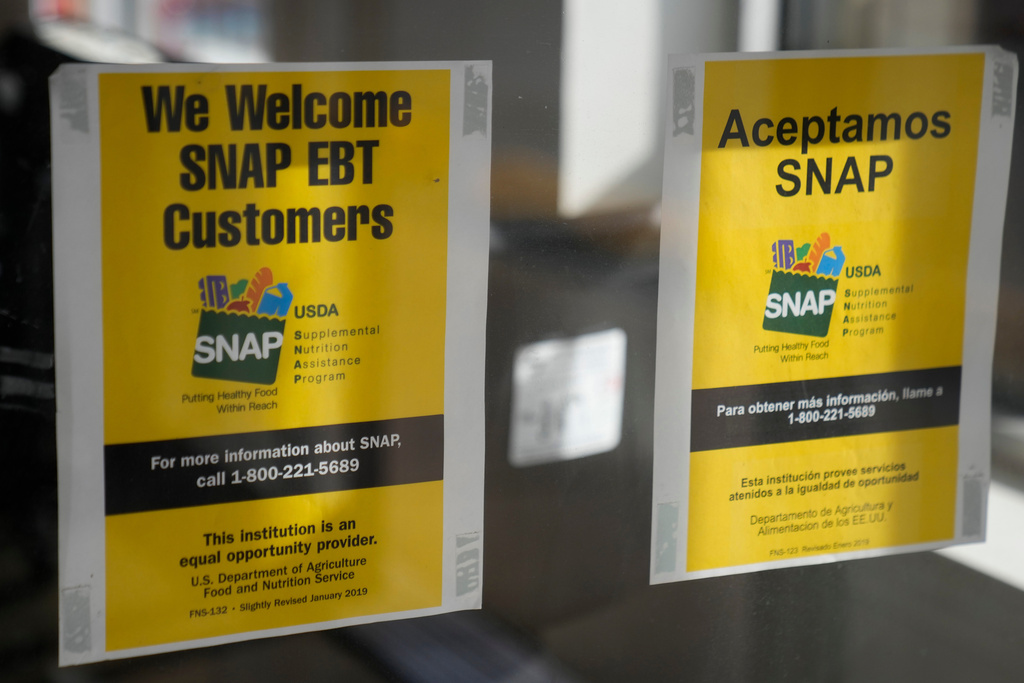
Signage showing that USDA Supplemental Nutrition Assistance Program (SNAP) is accepted, is displayed at Wild Onion Market, Monday, Oct. 27, 2025, in Chicago. (AP Photo/Erin Hooley)
The Alabama Department of Human Resources will also redirect an additional $3 million to Feeding Alabama’s food banks, bringing the total for the fiscal year to $9 million. The department will also send $300 to families who receive assistance through the Temporary Assistance for Needy Families program. More than 11,000 children in Alabama are enrolled in TANF, the governor’s office said.
Alabama DHR is also reviewing new guidance from the U.S. Department of Agriculture on how the partial SNAP benefits will be issued, but the state expects there will be delays in distributing the funds through Electronic Benefit Transfer cards, with the exact timing “unknown” at this time.
Ivey added that Alabama is stepping up to help fill the void left by the shutdown, but said the full responsibility remains with Congress to fund the government and its federal programs that Alabamians rely on.
“Hear me loud and clear when I say Alabama cannot be both the state and federal government,” she said. “And like states all across the country, Alabama is stepping up to help, but this is not sustainable by any means. U.S. Senate Democrats must vote to reopen the federal government now.”
The governor also rejected state Democrats’ plea to convene the Alabama Legislature for a special session to use Rainy Day funds to pay for SNAP.
“We have to stand up for our people,” Senate Minority Leader Bobby Singleton, D-Greensboro, said during a press conference Monday, urging Ivey to call for that special session. “If we don’t stand up for our people, who will?”
The state would need to be in proration in order to use the funds, according to the press release.
The eight food banks that will receive part of the $2 million are Community Food Bank of Central Alabama, Food Bank of East Alabama, Food Bank of North Alabama, Feeding the Gulf Coast, Heart of Alabama Food Bank, Selma Area Food Bank, West Alabama Food Bank and the Wiregrass Area Food Bank.


Follow Us