
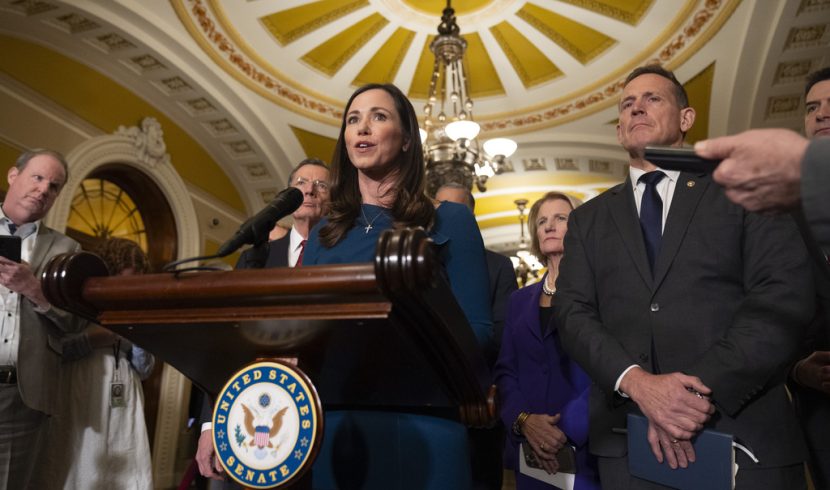
WASHINGTON — As the government shutdown becomes the longest in American history, bipartisan discussions in the Senate are gaining steam as lawmakers work to find a way out of the gridlock. They hope it could come as early as this week.
As an appropriator, U.S. Sen. Kate Britt, R-Ala., is playing a key role in conversations with her colleagues on both sides of the aisle as they search for an off-ramp to the “logjam” that’s plagued Congress for the past 36 days.
“I spent five and a half hours on the phone Friday, everything from Democrats to Republicans to White House, trying to forge a pathway forward,” Britt told Alabama Daily News.
“Same thing, calls on Saturday, calls on Sunday, yesterday…trying to figure out how do we make this happen. It is my goal to move this this week,” she added.
On Tuesday, for the 14th time, the Senate rejected the GOP-led House bill that would fund the government through Nov. 21. Republicans need five more Democrats to flip to pass a short-term funding measure.
But now that the original Nov. 21 funding deadline is less than three weeks away, senators are floating new stopgap funding bills that could run through December, right before Christmas, or through January. Britt is a proponent of a December deadline, while other Republicans are pushing for a measure that would fund the government through the beginning of next year.
“There is a conversation around what that next deadline would be,” Senate Majority Leader John Thune told reporters. “But the hope and expectation would be that we could get appropriations bills on the floor, get them considered and passed so that we can fund the government through the normal appropriations process.”
Appropriators like Britt are also pushing to advance a package of full-year spending bills soon to fund parts of the government, such as the Supplemental Nutrition Assistance Program, food aid for women and babies and Capitol Police.
“I certainly think that that three-bill package is primed to do a lot of good things for the American people,” Britt said.
At the heart of the impasse is the expiring Affordable Care Act subsidies. Senators have also been in talks this week about how to address those credits, which could include a separate vote on extending them. But no plans on that issue have been nailed down.
“We had a very good caucus and we’re exploring all the options,” Senate Minority Leader Chuck Schumer said after Democrats’ closed-door lunch meeting Tuesday.
Meanwhile, the suspension of SNAP benefits during the shutdown is beginning to be felt in Alabama. On Tuesday, the first beneficiaries in the state did not receive their food aid payments. Gov. Kay Ivey will now send $2 million in emergency funds to support eight food banks in the state.
The Trump administration plans to distribute contingency funds to partially pay for the program after a court ruling ordered them to do so, but delays are expected.
In Birmingham, the city council approved on Tuesday $1 million to support the 23,000 households in the city that receive SNAP benefits. U.S. Rep. Terri Sewell, D-Birmingham, expressed her support for the city’s efforts to help people put food on the table during the shutdown uncertainty.
“Hunger is not a political football,” Sewell said at Tuesday’s city council meeting. “Hunger is not just for Democrats and not for Republicans. It’s not a red or blue issue. Hunger is an issue for all of us to address.”
Speaker Mike Johnson, R-LA, said Tuesday he plans to bring the House back to Washington soon after the Senate passes a funding deal. The House has been out of session since Sept. 19.


Follow Us