
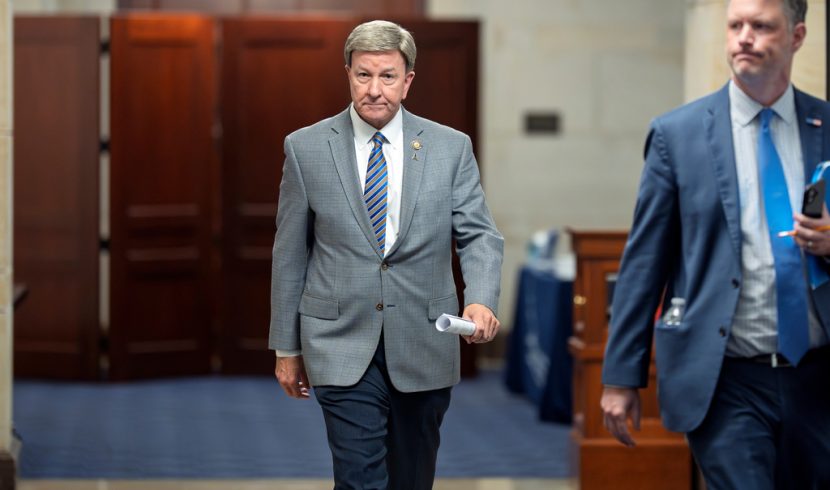
WASHINGTON — All of Alabama’s House members supported the annual defense policy bill Wednesday, authorizing $900 billion for the Pentagon and $197 million for construction at Alabama’s military bases.
The National Defense Authorization Act now heads to the Senate, where it’s expected to pass and be sent to President Donald Trump’s desk before the end of the year.
Rep. Mike Rogers, R-Saks, chair of the House Armed Services Committee, praised the passage of the legislation that received bipartisan support. It will raise service members’ pay by 3.8%.
“It will continue historic improvements in the quality of life for our service members and their families,” Rogers said on the House floor. “It will build the ready, capable and lethal fighting force we need to deter China and our other adversaries.”
For Alabama, the NDAA authorized $50 million for an access control point at Anniston Army Depot, $55 million for a propulsion systems building at Redstone Arsenal, $64 million for a warehouse at Anniston and $28 million for area maintenance support at Maxwell Air Force Base.
A central part of the bill focused on reforming how the Department of Defense buys weapons to get them in the hands of service members faster.
“Fixing acquisitions will go a long way toward ensuring our warfighters are the most capable fighting force on the planet,” Rogers said.
The defense policy bill includes construction and upgrades to housing, medical facilities and child care centers for troops and their families.
“We’re doing a dramatic improvement in their housing,” Rep. Gary Palmer, R-Birmingham, told Alabama Daily News. “These are our war fighters, these are the people who volunteered to defend the country. We need to do a much better job of taking care of them and their families.”
Tucked inside the legislation is a provision that would reduce Defense Secretary Pete Hegseth’s travel budget until he releases the unedited videos of the boat strikes against alleged drug smugglers.
The conference bill would also provide support to Europe, authorizing $400 million for each of the next two years for the Ukraine Security Assistance Initiative. Another provision would repeal the 1991 and 2002 authorizations for use of military force in Iraq.
Rep. Dale Strong, R-Huntsville, secured a provision to help alleviate bottlenecks at the gates of Redstone Arsenal. The bill allows the Department of Defense to contract security guards to help patrol gate access.
“This provision will ensure the thousands of employees, contractors and service members who travel through these gates will have secure and efficient access as Redstone’s mission continues to expand,” Strong said in a statement.
The NDAA also includes legislation from Rep. Shomari Figures, D-Mobile, to help cover cancer-related expenses for service members and their families that aren’t already covered by their health insurance.
“Our service members and their families give this country everything, and the least we can do is make sure they’re supported when they are facing a life-altering diagnosis like cancer,” Figures said.
Republicans touted how the bill will save $40 million by cutting diversity, equity and inclusion programs at the Department of Defense.
Rep. Terri Sewell, D-Birmingham, argued that the “bill could have been better” but said the responsibility of Congress to support the troops led her to vote for the legislation. She highlighted how the NDAA preserved $100 million for historically Black colleges and universities and minority-serving institutions.
“It remains my hope that House Republicans return to the bipartisan tradition of keeping partisan politics out of our national security,” Sewell said.
The dean of Alabama’s delegation, Rep. Robert Aderholt, R-Haleyville, noted that his bill to allow the Department of Defense Education Activity to offer dual enrollment programs for high schoolers was included in the House-passed legislation. Another provision he championed directs the DOD to consider the U.S. textile industry to help meet defense needs.
Other Alabama-specific provisions focus on expediting the construction of Space Command headquarters in Huntsville, selecting the state as a location for robotics autonomous systems training and limiting funding to transform the helicopter training program at Fort Rucker.


Follow Us