
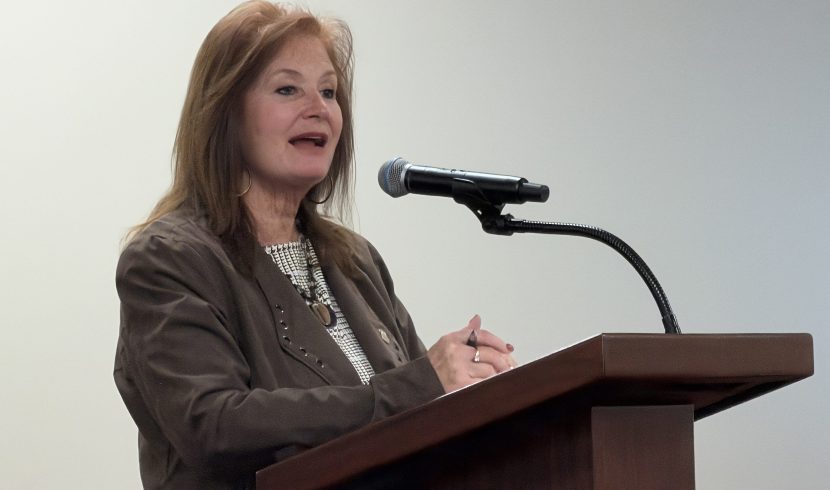
MONTGOMERY, Ala. – Education leaders from across Alabama urged lawmakers Wednesday to slow proposed changes to the state’s A-F school report card during a public hearing before the House Education Policy Committee, as Rep. Terri Collins presented a plan to revise how schools are graded.
Collins, R-Decatur, presented a revised version of House Bill 396 that she first introduced last week. The bill would change the formula used to calculate annual letter grades for schools. The committee did not vote on the bill Wednesday.
The revised bill is at the end of this article.
Alabama’s A-F law was passed in 2012, though the first report cards were not issued until 2018. The current system uses student achievement, academic growth, chronic absenteeism, graduation rates and college and career readiness to calculate each school’s grade.
Collins’ proposal would shift those weights, reducing the emphasis on graduation rates and chronic absenteeism, increasing the weight of achievement and college and career readiness, and adding a separate measure tracking the academic growth of a school’s lowest-performing 25% of students.
The bill would allow the state to raise the metrics needed to earn each letter grade after three years, based on recommendations from a newly created accountability council.
Collins said the changes are intended to promote continuous improvement and ensure school grades accurately reflect student proficiency.
“I would ask you to look at how many students are not proficient or grade level, and decide, does your grade truly represent what it’s saying?” Collins told committee members.
Nearly two dozen superintendents and school leaders filled the front rows of the committee room to oppose the changes, raising concerns about both the structure of the formula and how the proposal was developed.
Jefferson County Superintendent Walter Gonsoulin said his objection centered on process.
“It’s not the indicators itself, it’s the process that I have a problem with,” Gonsoulin said, urging lawmakers to work more collaboratively with educators.
Some education officials said lawmakers shouldn’t “change the rules during the game,” arguing that schools have worked for years under the current accountability system and shouldn’t have the grading formula changed now.
Chris Robbins, assistant superintendent of instruction for Hoover City Schools, said the proposal would effectively count some students twice by measuring overall growth and separately measuring growth among the lowest-performing 25% of students.
“What this means is that mathematically, schools are held accountable for the growth of 25% of their students twice on the same report card. Mathematically, that doesn’t make sense,” Robbins said.
Farrell Seymore, executive director of the Council for Leaders in Alabama Schools, warned that changing grading measures could cause some schools’ letter grades to drop even if performance does not decline.
“School grades influence more than just perception. It affects community reputation. It affects teacher recruitment, property values, business attraction. It affects workforce recruitment and economic development decisions,” Seymore said.
Several Republican and Democratic lawmakers said they support raising expectations but questioned whether educators had sufficient input and asked Collins to continue refining the bill before bringing it to a vote.
Collins defended the proposal as necessary to sustain the academic gains Alabama has seen in recent years.
“Raising the bar doesn’t erase our progress, it protects it,” she said.
Christy Hovanetz, a senior policy fellow at ExcelinEd who helped design Florida’s accountability system, said states that continue to raise expectations see stronger long-term results.
“The hardest time to raise the bar is when you’re doing well,” Hovanetz said.
A+ Education Partnership President Mark Dixon also spoke in support.
Dixon said the original A-F report card succeeded in drawing attention to school performance and creating urgency for improvement.
As more schools earn high grades, the standards for earning those grades should be strengthened, Dixon said.
“To sustain this momentum, we must raise the bar,” he added.
Collins said she will continue to work with educators to revise the bill and plans to bring it back to the committee next week.


Follow Us