

BIRMINGHAM, Ala. – Alabama students returning to school starting this week will encounter a few big changes – but none more immediate than a new statewide rule: Phones, earbuds and smartwatches must now be turned off and stowed away during the entire school day.
High schoolers this academic year will also see two major shifts: A new graduation requirement starting with this year’s Class of 2026 and a second diploma pathway focused on career preparation.
Cell phone ban
The ban is the result of the FOCUS Act, short for Freeing Our Classrooms from Unnecessary Screens, passed by state lawmakers this spring to curb distractions and reduce the negative mental health effects associated with student device use.
Under the new law, all public K-12 school systems must adopt and enforce a policy that limits student access to wireless communication devices during instructional hours – including while students are in the hallway or eating lunch.
Alabama is among 31 states and the District of Columbia that prohibits or restricts students’ use of cell phones, according to Education Week.
Research has shown that cell phones and other wireless devices can create major distractions, and may contribute to poor mental health among students. While most districts had policies in place to restrict cell phone usage during school hours, enforcement wasn’t always consistent or prioritized.
Under the new law, school boards were given until July 1 to pass their policy, meaning every district should have guidelines in place by the start of the school year.
The law says devices aren’t allowed in any public school building “unless the wireless communication device is turned off and stored off their person in a locker, car, or similar storage location.”
Some districts are sticking with the “off their person” language without pinpointing what “similar storage location” could be. Some districts are using a system of locking pouches – the most commonly known is the Yondr pouch – requiring students to lock up their phone until the school day ends.
Other districts are interpreting the rule in a less restrictive way.
In Autauga County, for example,Superintendent Lyman Woodfin described the language as a “gray area” during an online presentation of their district policy. As such, they’re allowing students to keep devices in a purse or backpack – as long as they’re turned off.
The law allows for exceptions, like if a student needs access to a device for medical purposes, such as a glucose monitor, or if the device is part of a child’s Individualized Education Program. If teachers want students to use their devices for instructional purposes, that’s allowed.
And if there’s an emergency threatening the life or safety of the student or another person, they can use their device.
How violations are handled is left up to each district. The law requires consequences for students who break the rules, and those consequences should be spelled out. Here, too, schools are taking different approaches.
Hoover City Schools, for example, outlines a progression of consequences for grades K-5 and 6-12 in a 9-step sequence beginning with a warning. Continued violations can eventually lead to placement in alternative school on the ninth offense.
Gadsden City Schools takes it further, referring parents to the local district attorney’s office on the third offense.
The law also includes provisions aimed at improving internet safety and protecting students from age-inappropriate content. Another requirement mandates that all public school students complete a course on internet safety and social media use before entering eighth grade.
New high school graduation requirement for the class of ‘26
The class of 2026 has one more box to check before earning their diploma: Graduates must earn one of 10 credentials showing they are ready for college or career.
Known as College and Career Readiness indicators, they were introduced after the state dropped the high school exit exam in 2013, but they weren’t required for graduation until 2026.
The CCR indicators are:
- Earning a qualifying score on the ACT,
- Earning a qualifying score of three or higher on an Advanced Placement test,
- Earning a qualifying score of four or higher on an International Baccalaureate test,
- Earning college credit while in high school,
- Earning a silver or gold level on the ACTWorkKeys test,
- Completing an in-school youth apprenticeship program,
- Earning a career technical industry credential from the list approved by the Alabama Committee on Credentialing and Career Pathways,
- Being accepted into the military before graduation,
- Attaining career and technical education (CTE) completer status,
- Any other CCR indicator approved by the state board of education
New high school diploma track available
High school students now have two pathways to earn a diploma: the traditional “four-by-four” curriculum known as Option A, and a new career-focused diploma known as Option B. Created by lawmakers in 2024, the Workforce Pathways Diploma offers a career-focused alternative to the traditional college-prep track.
Students are now able to swap upper-level math and science for hands-on courses in fields like welding, health sciences and automotive repair while they’re in high school if their high school offers the coursework.
Students and families should have received information about the pathways during registration. And students need to know that some four-year universities may not accept students who graduate under Option B.
Officials say students who take Option B in 11th grade may still have time to switch back to the traditional college-prep route if they change their plans. But once they enter senior year, it may be too late to make the change and meet college entrance requirements.
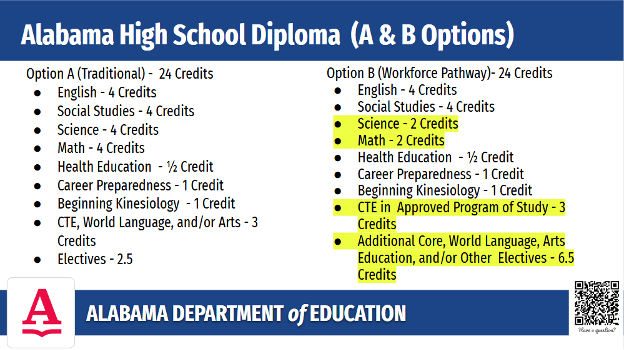
For example, the University of Alabama requires three credits in math and science. If a student is missing a class, they might be able to take a remedial class at the university. Or they could make up the coursework at a community college and transfer into the university.
The Alabama High School Athletic Association has confirmed that students choosing Option B will remain eligible to participate in high school sports.


Follow Us