

BIRMINGHAM, Ala. – Alabama’s newest teacher preparation report cards offer more and in some cases concerning information about how well the state’s colleges are preparing future teachers.
They reveal uneven performance on required certification tests, indicators of teacher readiness, and new data tied to the state’s ongoing teacher shortage.
State leaders in recent years have focused on teacher preparation as a lever to improve K-12 student outcomes, particularly in early reading, where Alabama has historically lagged national averages.
Lawmakers and education officials have tied stronger preparation, especially in reading instruction, to broader efforts to improve literacy outcomes in early grades.
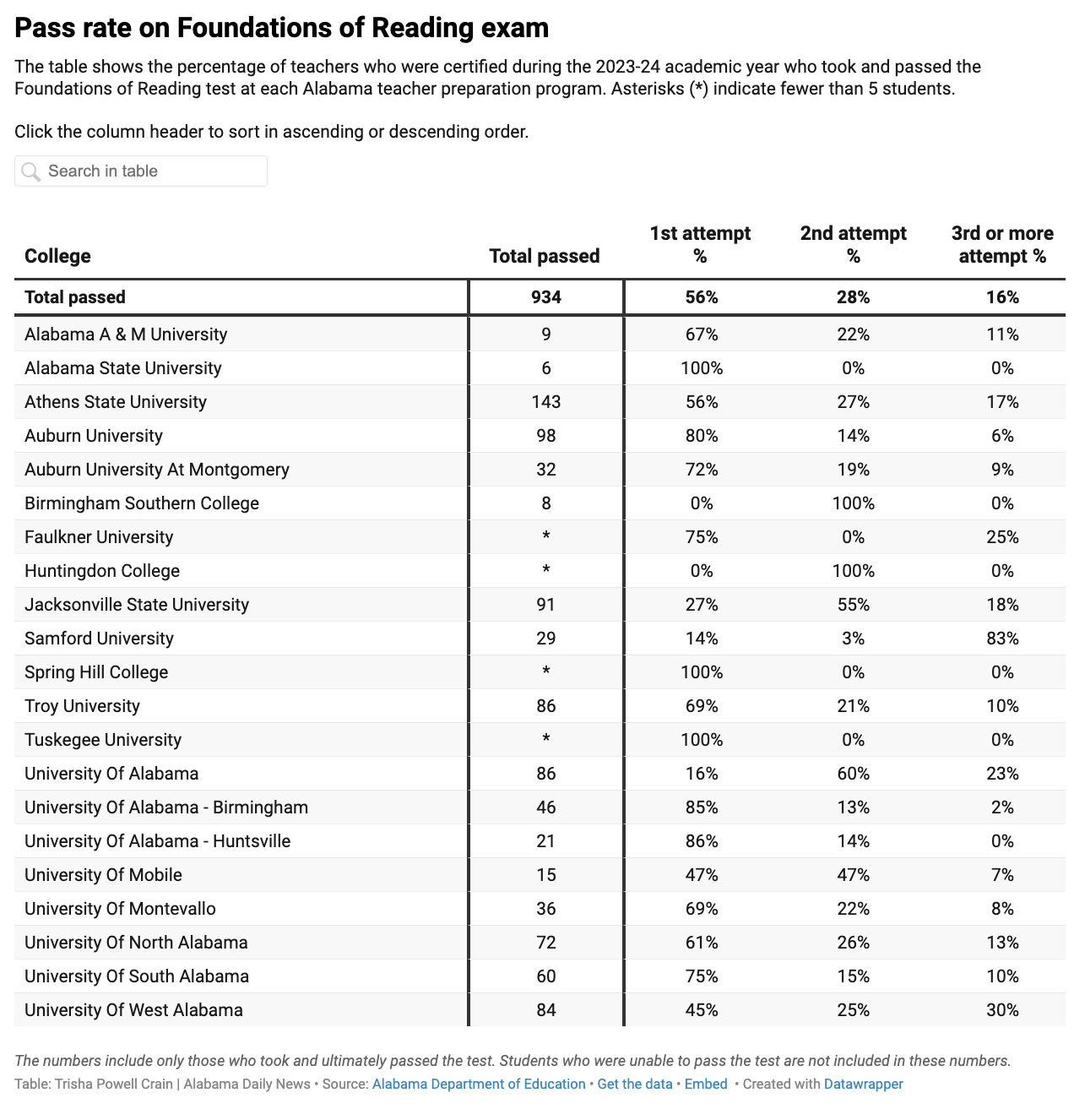
One of the most notable findings involves early reading instruction. Statewide, of the 934 prospective elementary teachers who took the Foundations of Reading test, just 56% passed it on the first attempt. Another 28% passed on the second attempt, while the remaining 16% passed on the third or later attempt.
The data reflect teachers who were certified during the 2023-24 school year and include only candidates who ultimately passed the required tests. They do not capture candidates who took certification exams but never passed them.
“That’s concerning that only 56% of our students are passing it on the first attempt,” State Superintendent Eric Mackey told state board members during a recent work session. “It just means there’s work to be done.”
The Foundations of Reading test is a relatively new requirement, adopted in 2022. Those seeking certification in early childhood education, elementary education and elementary collaborative special education must pass the test to become certified.
The state Board of Education must approve all teacher preparation programs, including which certification tests candidates are required to take and the minimum scores needed to pass those exams.
The percentage of candidates passing the reading test on the first attempt was lower than the previous year’s report cards, when 86% of 260 test-takers passed on the first try, 8% passed on the second attempt and 7% passed on the third or later attempt.
Results varied widely by institution. Six colleges reported first-attempt pass rates between 80% and 100%, eight had rates between 50% and 79%, five had fewer than half of test-takers pass on the first try, and two colleges reported that none of their candidates passed on the first attempt.
The table below shows the pass rates by college. An asterisk (*) indicates there were fewer than five students who passed the test. Click here if you’re unable to see the table.
 Mackey said looking at how many attempts candidates need to pass the test provides insight into both institutional preparation and the support candidates receive afterward.
“The first-time pass rate tells me how well the institutions (colleges) do,” he said.
“The second-time pass rate tells more about how well the tutor did. And then, if it takes three or four times – how many tutors it took. Ultimately, if the institution’s doing their job, they don’t have to take it two, three, four times.”
The reading exam is only one of several test results included in the report cards. Results are also provided for the pedagogy test, which measures candidates’ understanding of the craft of teaching, and for content-area tests tied to the subjects they plan to teach.
For the first time, the information is presented through a new interactive dashboard that allows users to compare teacher preparation programs across institutions.
Education officials say the format is intended to make the data more accessible, particularly for prospective teachers who want to understand how well programs prepare candidates for certification.
Teacher preparation report cards had been published for many years, but were reintroduced in 2018. Until this year have been published only as individual PDFs for each college, making statewide comparisons difficult.
The updated report cards also include more detailed breakdowns than in prior years, with test results disaggregated by gender and ethnicity.
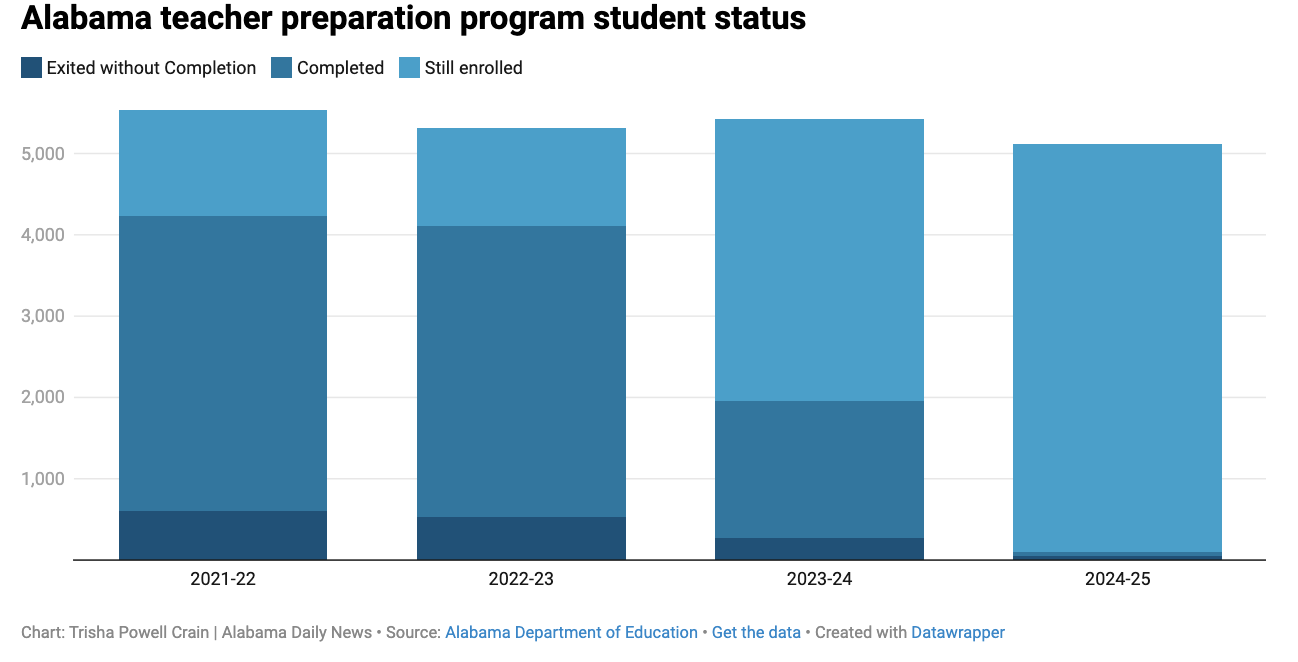
New this year is data showing how many students begin coursework toward becoming a teacher but leave their preparation programs before completing them, along with limited information about why they exited.
State officials said they have not previously collected data on students who left teacher preparation programs before completion, and some colleges were not tracking that information. As a result, the new report cards provide an initial, but incomplete, picture of attrition.
“You might see some institutions with none,” teacher certification administrator Alethea Hampton said. “It may not be that there were none. They just were not collecting that information so they could not report on that.” She said all colleges will be required to collect the information going forward.
The chart below shows the number of students who completed or exited teacher preparation programs, along with those who remained enrolled.
Click here if you are unable to see the chart.
As for why students exited their programs, the state identified nine possible reasons, including failing a required test, GPA issues, financial challenges, personal reasons, or deciding to change majors. A catch-all “other” category was also included – and it was the most frequently selected response across all reporting years.
The second most common reason cited was personal reasons. The third most common reason among students who exited programs in the 2024–25 school year was deciding against teaching as a profession. Exact counts are not available for reasons with fewer than five responses.
“We need to understand why they are leaving education in the place,” Hampton said. “Because if we can understand the why, then we can begin to work on those things that are causing individuals to depart the profession before even becoming certified.”
Beyond preparation and attrition, the report cards also provide new data on Alabama’s ongoing teacher shortage. The dashboard includes information on the number of teaching positions filled by a teacher who is not certified statewide and by district, broken down by subject area.
When certified teachers are not available, schools sometimes hire long-term substitutes or teachers who obtain emergency certification – meaning they are working toward becoming a teacher but haven’t completed all of the steps yet.
Statewide, for the current school year, 751 elementary teaching positions have been filled by a teacher who is not certified as an elementary teacher. The second largest shortage is for early childhood teachers, where 356 positions are filled with uncertified teachers.
Shortage areas vary by district. In Mobile County, the state’s largest school district, the largest shortage is for collaborative special education teachers in elementary grades, with 35 positions filled with teachers without that certification. The second-largest shortage is for elementary teachers, with 31 positions.
In Huntsville City schools, the largest shortage is for elementary teachers, with 87 positions filled by teachers without that certification. The second-largest shortage is for performing arts teachers, where 20 teachers are teaching without the appropriate certification.
Hampton said the shortage data can help colleges better understand where the demand is greatest. “Hopefully that will help with their recruitment efforts,” she said.


Follow Us