
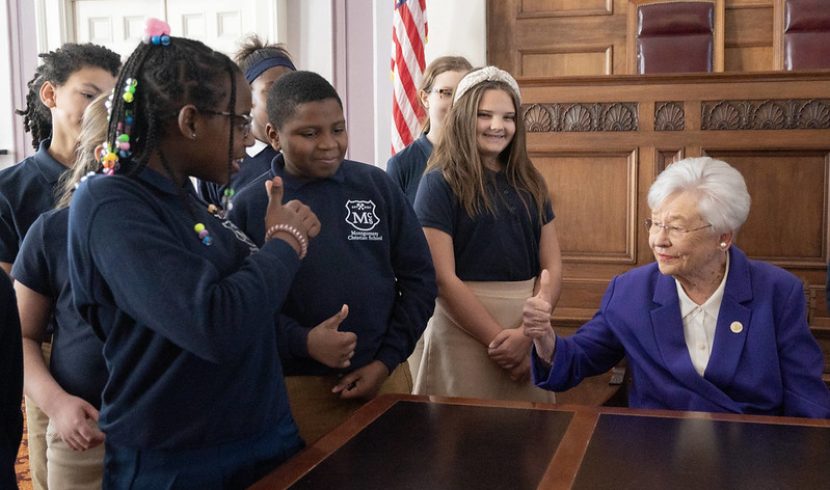
MONTGOMERY, Ala. – When Montgomery Christian School opened in 2007, it was one of many private schools in the area offering families an alternative to their local public schools.
Nearly 20 years later, and more than a decade after becoming an early participant in Alabama’s first private school scholarship program, school leaders say a newer education savings account program is helping open additional doors for families seeking a private education.
Alabama now operates two state-supported programs aimed at helping families afford private school: a long-running tax credit scholarship program and the newer education savings accounts, or ESAs, created under the CHOOSE Act.
The CHOOSE Act created state-funded education savings accounts – up to $7,000 for students attending private schools – allowing families to receive public dollars directly for approved educational expenses. About 19,000 students are currently using the accounts, including approximately 12,600 students attending private schools. Unlike tax credit scholarships, which rely on private donations, the accounts are funded by the state.
During a recent visit, school officials told Alabama Daily News that the CHOOSE Act’s education savings accounts are generating new interest among parents who want help paying tuition at the K-6 school.
The school also moved into a larger building at the start of the current school year, a change that allows Montgomery Christian to expand enrollment and add grade levels over time. School leaders said the move comes as interest in private school options continues to grow.
Allison Jackson, a former teacher who now leads parent development efforts at Montgomery Christian, said staff recently held a parent meeting focused on the new program.
“Once a month, we have a coffee with parents, and this month we focused on the CHOOSE Act,” Jackson said. “They just want to learn more.”
Applications for new families seeking ESAs for the 2026-27 school year opened Jan. 2, and renewal applications are also underway.
Just over 30 students at Montgomery Christian School are currently using ESAs to pay for school-related expenses, according to data from the Alabama Department of Revenue.
Head of School Pam McLemore said Montgomery Christian has long focused on providing an academically challenging education for families who want that for their children, regardless of income.
“We have been providing that academically challenging education to families with limited resources since the beginning,” McLemore said. She added that students at Montgomery Christian typically score well above grade level on the Iowa Test of Basic Skills, a nationally normed assessment.
About 170 students currently attend the school, McLemore said, and families who need financial assistance beyond what is available through state programs are able to receive support through the school’s fundraising efforts.
State involvement in private school funding is still fairly new in Alabama.
Alabama first formalized state support for private school choice through the Alabama Accountability Act in 2013, which allows eligible students to attend participating private schools using tax credit scholarships. Under the program, donors receive a dollar-for-dollar state income tax credit for contributions used to fund scholarships of up to $10,000 per student.
About 3,900 students statewide received tax credit scholarships during the 2024-25 school year, including about 80 students at Montgomery Christian School. Data for the current school year is not yet available. Public reports show Montgomery Christian has typically enrolled between 50 and 85 students each year using the scholarships.
Private schools make up a sizable but hard-to-measure part of Alabama’s education system. An estimated 82,000 students attend private schools statewide, compared with about 720,000 students enrolled in public schools. While hundreds of private schools operate across the state, from small faith-based schools to larger institutions, Alabama does not collect uniform enrollment data for private schools.
As a result, numbers reported for the Accountability Act and the CHOOSE Act are one of the few ways the state can see how many students are using public funds to attend private schools.
For McLemore, the state’s expansion of school choice affects how families approach private education.
“I hope what school choice will bring is honor back into education,” she said. “If we’re going to partner with parents, that means we have an equal playing field.”
She said education savings accounts allow parents to see private school as a choice they are making for their child, rather than help they are receiving – something she believes matters for families who have long wanted private education but previously couldn’t afford it.

Follow Us