
WASHINGTON — Now that open enrollment for the Affordable Care Act marketplace has opened, insurance navigator Mark Linn’s phone is ringing about eight times a day with Alabamians calling for help with enrolling in health coverage.
The first week of open enrollment is usually one of the busiest times for Enroll Alabama, a federally funded program that assists individuals with purchasing plans through Healthcare.gov. But this year, those who want coverage are facing a new challenge.
“I would say that one of the differences this year is that, obviously, a lot of people are worried about what they’re hearing on the news in regards to the additional tax subsidies, which are set to expire on Dec. 31,” Linn told Alabama Daily News.
Affordable Care Act premiums are set to rise by up to 27% next year in Alabama or an average of 20%, as a result of rising health care costs and expiring subsidies. Around 477,000 Alabamians receive insurance through the marketplace.
After Congress passed a measure to end the shutdown this week that does not include an extension of the enhanced tax credits, it’s unclear how the issue will be addressed in the final two months of the year.
That’s leaving Debbie Smith with Alabama Arise’s Cover Alabama campaign feeling distressed and fearful of how Alabamians will be able to continue to afford insurance in 2026.
Roughly 130,000 Alabamians could be priced out of health coverage next year if the subsidies lapse, according to Alabama Arise.
“It’s been kind of overwhelming, honestly,” she told Alabama Daily News.
If that many people drop health insurance coverage, it would also have an impact on Alabama’s state budget. Blue Cross and Blue Shield of Alabama estimates that lost premium tax revenue for the General Fund will total about $17 million in 2026.
“If Congress extends the tax credit, we expect the marketplace to update eligibility automatically, ensuring members receive the support they need,” spokesperson Sophie Martin told ADN. “We believe the ACA marketplace must remain affordable, stable, and responsive to those who depend on it.”
Hospitals are also closely watching the conversations around the subsidies. Danne Howard, president and CEO of the Alabama Hospital Association, said there’s no concrete way to prepare for an influx of uncompensated care.
“It’s going to be an eventual thing, but clearly, individuals that can’t afford to pick up coverage on their own now are going to have some health issues and access to care issues moving forward, which will strain hospitals as the only place they have to go will be an emergency department,” Howard told ADN.
Statewide hospitals provide $650 to $700 million in uncompensated care every year, Howard said.
When Alabama Daily News asked U.S. Sen. Tommy Tuberville, R-Ala., about his thoughts on extending the subsidies, he said he wanted to “start this thing over,” referring to the ACA marketplace. But he contended it would be difficult for Republicans and Democrats to agree on how to do it.
“I’d love to see the insurance companies start adding plans to make it easier for people to buy health insurance,” Tuberville told ADN last week.
Every day, Smith said she learns of new stories about how the rising premium costs are impacting those in the state.
“I’m getting examples of people’s premiums, either doubling, tripling, in some cases, it’s 10 times the amount that it was before,” Smith said.
For example, a single woman in Birmingham received notice that her monthly cost for a bronze plan (which has lower premiums and higher out-of-pocket costs) would be about $314 in 2026, an increase of nearly $250 from what she’s paying this year at around $68. The woman has had no household changes, meaning the increase is a direct consequence of higher premiums.
On average, a benchmark ACA plan in Alabama for a 40-year-old enrolled in the second-lowest cost silver plan will cost $645 next year, rising from $535 this year, according to health policy research group KFF.
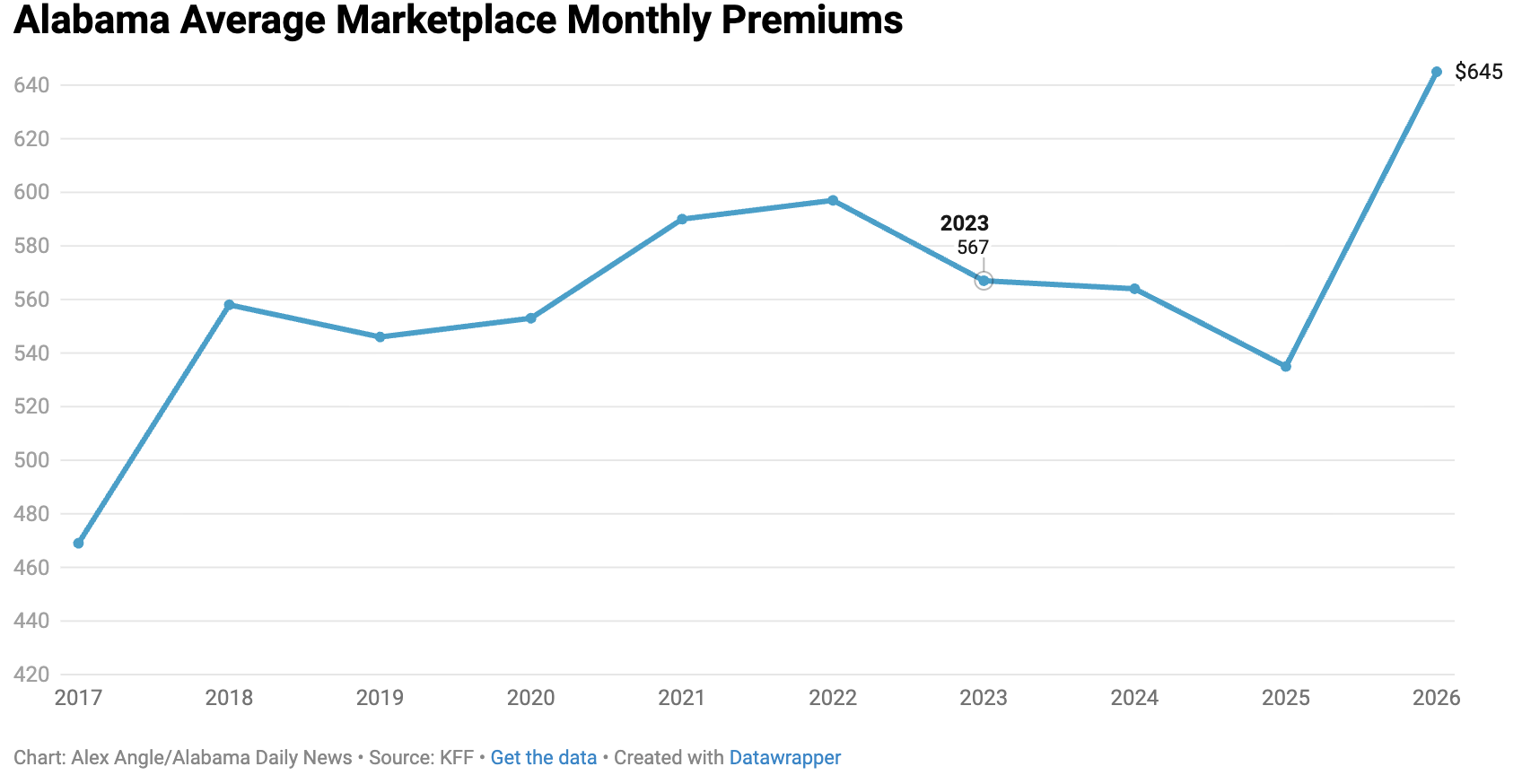 Click here to interact with the graph.
In 2021, Democrats expanded the ACA subsidies to increase the amount of financial assistance available for eligible enrollees and made the credits available to those who have incomes above 400% of the federal poverty level. The subsidies were renewed in 2023 and are paid directly to the insurance company. If the enhanced credits expire, many enrolled through the marketplace will either receive a smaller subsidy or will lose the credits altogether.
And if people are turned off from enrolling in expensive coverage options this year, it could be years before they decide to come back to the marketplace.
“I imagine a lot of folks who are getting signed up this year or try to get signed up, may just call it a loss and try again in three or four or five years,” Linn said.
The loss of those opting for no health coverage or a less comprehensive plan next year could have a cascading impact across the state beyond just those who rely on the marketplace.
“Our health care system (will suffer) because there’s going to be more people going to the hospital who are uninsured, and the system is going to have to absorb that cost, and they absorb that really, by passing it on to you, to patients, to Alabamians,” Smith told ADN.
Howard said the association has “always promoted and been supportive of ways to try to close the coverage gap” and the potential loss of the enhanced tax credits only adds to the need to advocate for that. The organization is closely watching for details on any proposal that comes out of Congress before the end of the year.
For now, Linn recommends Alabamians who receive insurance through the marketplace check out their options online, where they can make changes to their plans until mid-January. You can get assistance navigating insurance options through Enroll Alabama.


Follow Us