
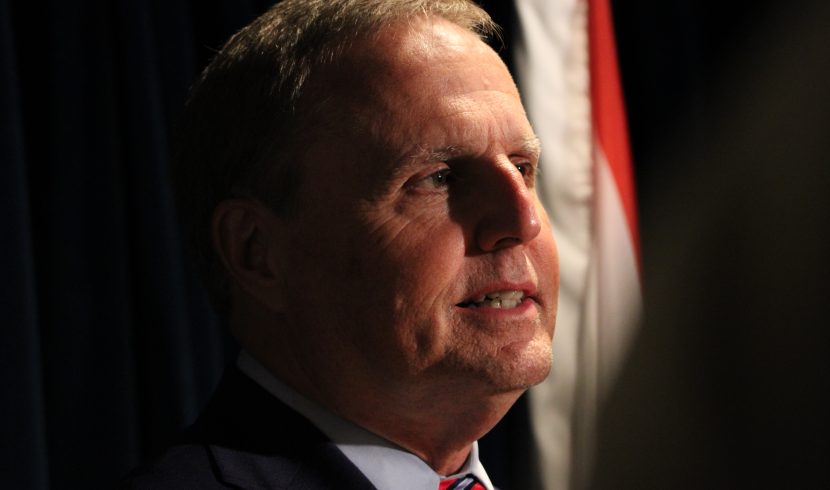
BIRMINGHAM, Ala. – Alabama House education budget committee Chairman Danny Garrett, R-Trussville, is pushing for passage of bills he has filed to give schools more autonomy and flexibility while adding more transparency for the public.
Taken together, the measures reflect Garrett’s broader push to reduce statutory mandates in education law and shift more decision-making authority to local school systems and higher education institutions. As education budget chairman, he said that flexibility is increasingly important as schools face shifting enrollment and uncertainty around funding.
All four bills are expected in House committees this week.
House Bill 152 would undo a 1965 law mandating the University of Alabama to have a standalone graduate school of social work. Garrett said the mandate was created at a time when the state needed more social workers, but that he believes the requirement is no longer necessary.
“They’re a little bit handcuffed by the fact that we require them to have that on the books,” Garrett said. If the bill becomes law, UA would have the option to continue operating a standalone School of Social Work or to house the program within a different college.
UA officials said they look forward to continuing to graduate “highly skilled, highly versatile social work practitioners.”
“We will continue to build upon that foundation, and this statutory change will provide the University autonomy over curriculum, organization and continued innovation in meeting the needs of the state and our students,” officials said in a statement to ADN.
A second bill, House Bill 151, removes the mandate for the University of Alabama to maintain a Physicians Advisory Board, first required by law in 1943. If UA wants to keep the board, they can do so, Garrett said, but it will be up to them to decide.
“This just says it’s your business, not ours,” he said.
House Bill 178 would allow city school systems to consolidate if they choose to do so.
“Under current law, a county and city system can combine,” he said.
Garrett said it is likely time that some smaller city school systems consider combining resources to better serve students.
“I want to give cities the opportunity,” he said. “I want the public education people to (see that they have) all the tools in the toolbox.”
For now, Education Trust Fund revenues are “holding their own” and growing a little, he said, but that could change. He believes those revenues are divided over too many systems.
“They need to stretch the dollars they get further,” he said. “So it’s possible that there may be two cities that realize together they might have more money to put into the classroom and more money for what they need.”
According to an Alabama Daily News analysis, 13 school districts – six cities and seven counties – enroll fewer than 1,000 students. Four of those have fewer than 750 students:
- Linden City schools in Marengo County: 402 students in three schools,
- Barbour County schools: 550 students in two schools,
- Elba City schools in Coffee County: 588 students in two schools, and
- Perry County schools: 740 students in two schools
As part of the broader effort to inform the public, Garrett said he wants Alabamians to understand how dependent the state is on federal funding.
He filed House Bill 165 to require postsecondary education institutions to break down and report how much federal funding they receive, how it is used and how they would respond if that funding were reduced.
“I think a lot of people are not aware of how heavily dependent our state is on federal dollars,” he said.
Senate Education Budget Chair Arthur Orr, R-Decatur, is sponsoring the same bill in the upper chamber.
One piece of legislation that has not yet been filed, but will be “very soon,” Garrett said, is a bill that would incentivize colleges and universities to improve outcomes for graduates through a performance-based funding system.
A joint committee of education budget committee members met twice in recent months to hear from experts about how to structure that type of funding. In 2024, performance-based funding was distributed to two-year colleges in 28 states and in four-year colleges in 21 states, according to the State Higher Education Executive Officers Association.
Beyond passing these bills, Garrett said his priorities for this session are making sure the CHOOSE Act – which created education savings accounts – and the RAISE Act – which provides additional funding to K-12 public schools for high-needs students – are properly funded. He said he is also looking back at previous investments the legislature and taxpayers have made in the state’s K-12 through postsecondary systems.
Updated 11:55 a.m. with statement from University of Alabama officials.


Follow Us