
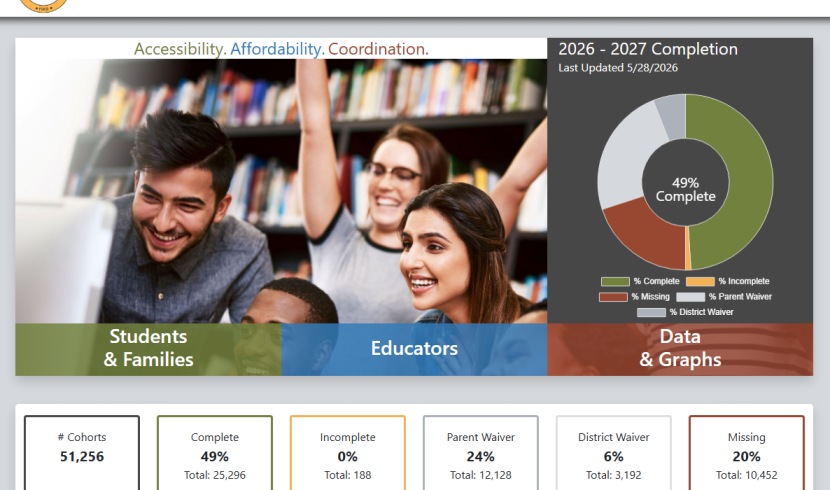
BIRMINGHAM, Ala. – While nearly half of Alabama’s public high school seniors have completed the Free Application for Federal Student Aid, more than 15,000 Alabama public high school seniors have parent or district waivers from the state’s FAFSA graduation requirement, according to new data from the Alabama Commission on Higher Education.
Another 10,452 students in the Class of 2026 have not yet completed the Free Application for Federal Student Aid, or FAFSA, as of May 28.
Alabama requires public high school seniors to complete the FAFSA before graduation or have a waiver on file. Parents may submit a waiver if a family chooses not to complete the form. School district officials also can submit waivers.
The latest ACHE data show 24% of the state’s 51,256-student cohort had parent waivers and 6% had district waivers.
The current FAFSA cycle runs through Sept. 1, so those numbers will continue to change.
But the previous two graduating classes also saw high waiver use: 33% of Alabama’s public high school Class of 2025 had parent or district waivers, compared with 35% of the Class of 2024.
FAFSA completion also increased by the end of each cycle, with just over 60% of the Class of 2025 completing the form, compared with 57% of the Class of 2024.
Why FAFSA completion matters
The form is the first step toward finding out whether a student is eligible for federal Pell Grants, loans, work-study and many state or college-based aid programs.
ACHE Executive Director Jim Purcell said completing the FAFSA is a critical step toward making higher education more affordable.
“Completing the FAFSA is a critical step toward making higher education more affordable and helping students achieve their academic and career goals,” Purcell said. “ACHE remains committed to supporting Alabama’s FAFSA completion efforts and providing students and families with information and resources related to postsecondary opportunities.”
Nationally, undergraduate students received an average of $16,810 in financial aid per full-time equivalent student in 2024-25, according to the College Board’s Trends in Student Aid report.
That included an average of $12,080 in grants, which do not have to be repaid, and $3,790 in federal loans. The maximum Pell Grant was $7,395, as it is for the 2026-27 award year, though actual awards vary by student, school costs and enrollment status.
Even though most students have already graduated, students still have time to complete the form. But college financial-aid priority dates vary by institution, meaning students who wait may still qualify for federal aid but could miss out on limited campus-based aid.
Nationally, FAFSA completion has rebounded after the troubled rollout of the shorter federal form. The National College Attainment Network reported that 55% of high school seniors nationwide had completed the FAFSA by May 1, an all-time high for that point in the cycle.
NCAN’s national numbers include public and private school students, while ACHE’s dashboard tracks public high school students.
Graduation requirement
The state board of education made FAFSA completion a graduation requirement beginning with the Class of 2022, after years of concern that Alabama students were leaving tens of millions of dollars in federal aid unused.
The requirement also came as Alabama officials were pushing to increase the number of residents with education or training beyond high school.
In 2019, Gov. Kay Ivey set a goal of adding 500,000 credentialed workers by 2025, and state officials continue to emphasize education and training after high school, whether through a two-year college, four-year university or workforce credential.
Research has consistently shown that higher levels of education are linked to higher earnings and lower unemployment. ACHE’s own employment outcomes data for Alabama graduates also show earnings rising as education levels increase.
Jim Hood, ACHE’s deputy director of financial information systems, said FAFSA completion fits ACHE’s work around affordability, accessibility and coordination because it can put more financial aid in students’ hands and connect students with postsecondary opportunities.
“We feel like FAFSA completion is a gateway to higher education,” Hood said.
ACHE’s public dashboard
The dashboard is more than a public reporting tool, Hood said. ACHE receives student, counselor and career coach email addresses from the Alabama State Department of Education and sends reminders during the year, including general messages and targeted nudges based on whether a student has started or completed the FAFSA.
Hood said ACHE also intentionally built public awareness and “gamesmanship” into the dashboard through school- and district-level metrics and award levels.
The goal is to let schools see how they compare with peers and keep FAFSA completion in front of students, counselors and administrators, he added.
Some schools are using that visibility to celebrate high completion rates. Butler County Schools recently congratulated Georgiana School in a Facebook post for reaching 100% FAFSA completion among its graduating class.
Opting out
Still, a large number of students meet the graduation requirement without completing the FAFSA.
State data does not show why families opt out. National research suggests students and families skip the FAFSA for a range of reasons.
The National Center for Education Statistics found that among high school graduates who did not complete the FAFSA, 33% thought they or their family could afford school without financial aid, 32% thought they might not qualify, 28% did not want to take on debt, 23% did not have enough information about how to complete the form and 22% did not plan to continue education after high school.
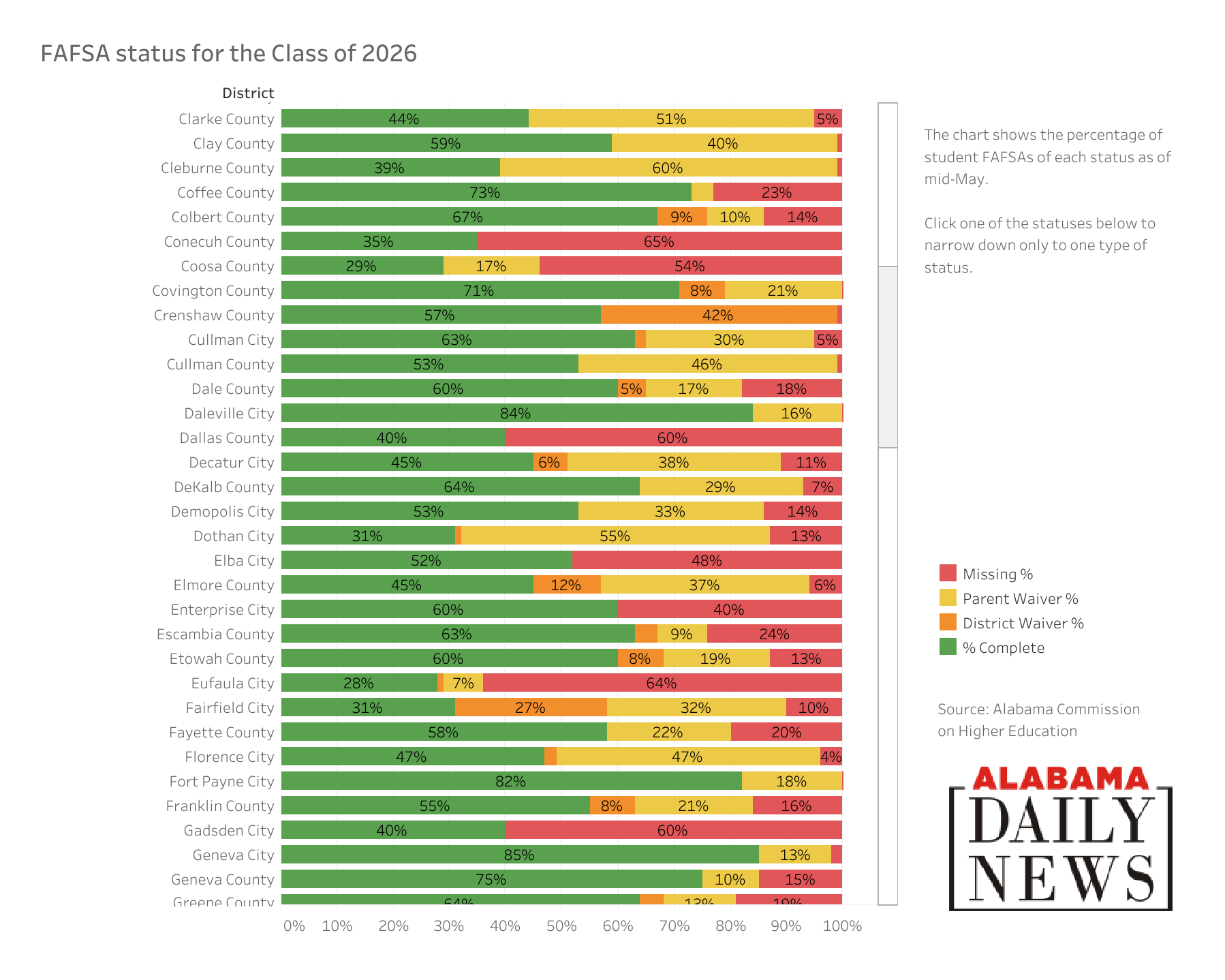
Here’s a look at FAFSA completion rates, along with the percentage of students who have parent waivers, district waivers or no FAFSA filing yet. Click here if you are unable to see the full table, which is best viewed on a larger screen.
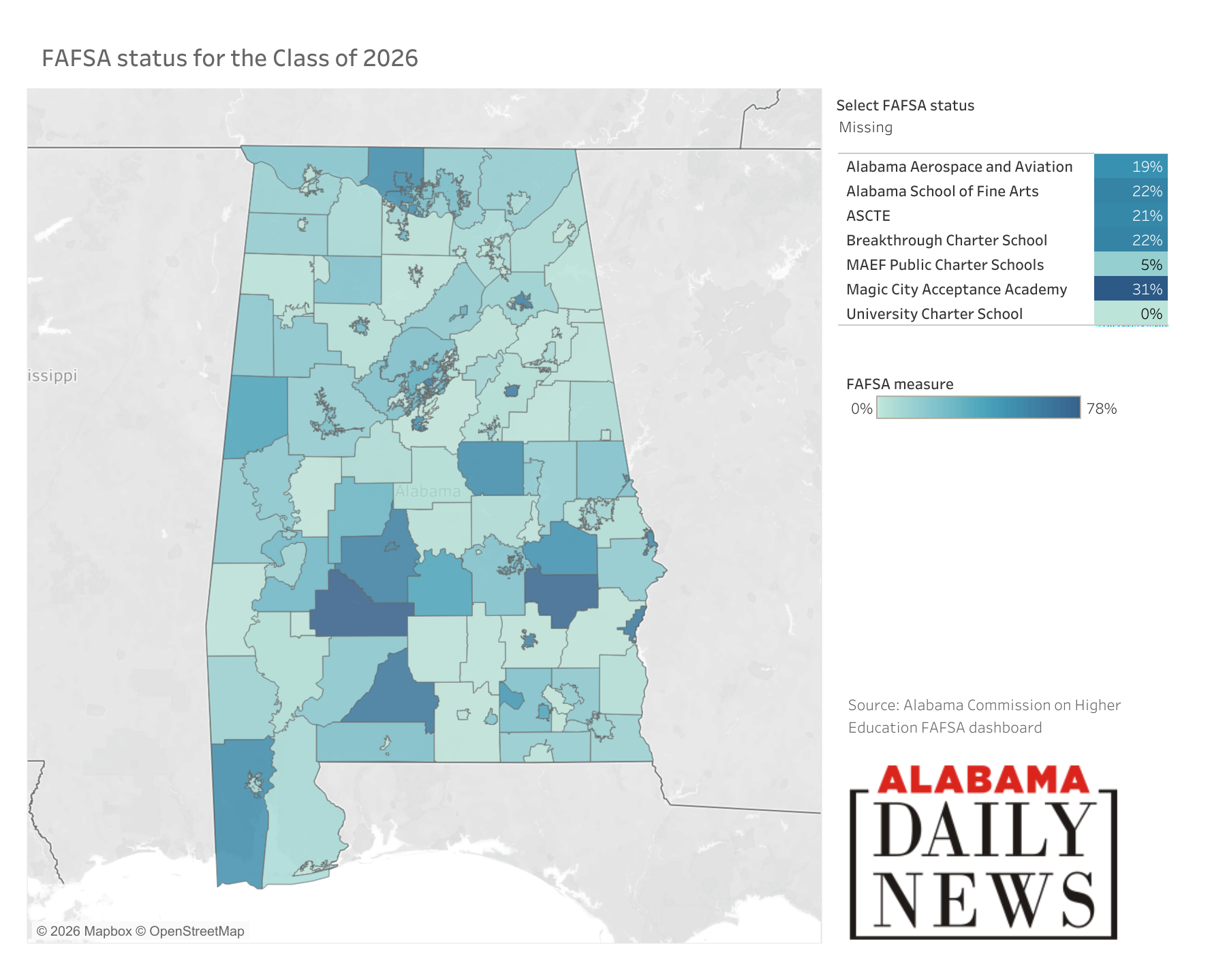
The map shows traditional school districts, while charter and specialty schools are listed separately in the table. Use the dropdown menu to choose which status to view.
Click here to open the map in a separate window, as it is best viewed on a larger screen.


Follow Us