

BIRMINGHAM, Ala. – Alabama’s school voucher program has drawn more than 37,000 applications for the 2026-27 school year, outpacing last year’s mid-March total even as the number of first-time applicants trails last year’s pace.
Of the applications submitted through March 9, 20,665 are from new students and 16,459 are renewals. Slightly more than 19,000 students are using their ESAs for the current school year.
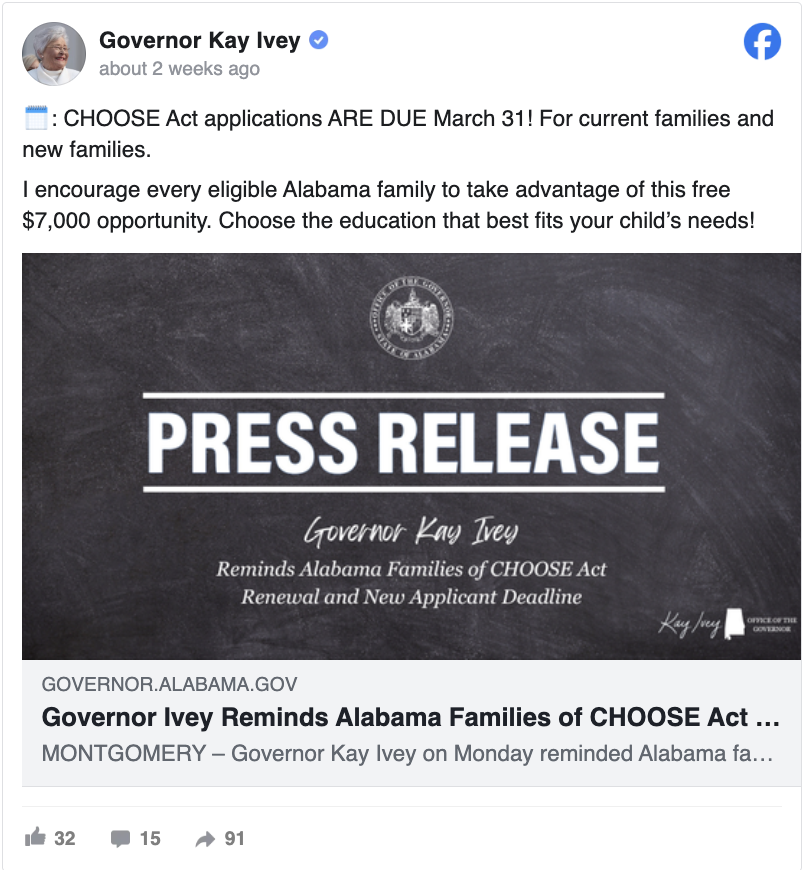
Gov. Kay Ivey on Monday urged families to apply before the March 31 deadline.
“The CHOOSE Act is giving families across our state the opportunity to choose the education that best fits their children’s needs,” Ivey said in a news release. “With the March 31 deadline fast approaching, I encourage every eligible family to take advantage and submit their application or renewal. Don’t miss this opportunity — get your application in before March 31!”
Families will receive award notices on April 15.
Just above 19,000 students are using ESAs for the current school year at a cost of approximately $100 million. The program is expected to expand further for the 2027-28 school year.
Ivey requested an additional $100 million for the CHOOSE Act as part of her FY27 education budget proposal, which the House kept in place when it approved its version of the budget on March 13.
The Senate Education Budget Committee is expected to take up the budget on April 1. If approved, that would bring the total amount available for the 2027-28 school year to $250 million.
Data provided to Alabama Daily News by the Alabama Department of Revenue in response to an information request offer a clearer picture of who is applying. The department provided a breakdown of applicants by renewal status, current school setting, gender, entering grade level, race and whether the student has special needs.
The law states that the first 500 ESAs must be reserved for students with disabilities, but the number of applicants far exceeds that figure: nearly 4,000 applicants reported having special needs. The state did not provide a breakdown showing how many of those students have Individualized Education Programs, or IEPs, versus Section 504 plans.
The data also show the program remains most popular among students already enrolled in private schools. Nearly 17,300 applicants currently attend private schools, compared to about 5,500 in traditional public schools and about 200 in public charter schools. About 10,300 are homeschooled, while just over 3,500 did not report where they attend school.
The table below shows the applicants by new or renewal status and by current school type. Click here if you’re unable to see the table.
The program is far more popular among white students than any other race or ethnicity, according to the breakdown from ALDOR. Totals and a breakdown by renewal applications and new applications are in the table below. Click here if you are unable to see the table.
Nationally, Alabama is part of a growing number of states offering education savings accounts. The nonprofit EdChoice, which supports school choice options like education savings accounts, lists 20 states with 23 ESA programs, though six of those programs are limited to students with disabilities.
Nine states have universal ESA programs, meaning there are no income eligibility requirements. Florida has the largest ESA program, with more than 280,000 students participating. Arizona has the second-largest program, with 102,000 students.
Texas recently enacted an ESA program. More than 229,000 students have applied as of March 17. State lawmakers allocated $1 billion for the 2026-27 school year.
The CHOOSE Act, short for Creating Hope and Opportunity for Our Students’ Education Act, was enacted in 2024, creating Alabama’s first statewide education savings account program. It allows eligible families to use public funds for approved education expenses outside the traditional public school system.
To qualify for the upcoming school year, a student must be an Alabama resident. Priority is given to dependents of an active-duty military member and students zoned to attend a “priority” public school – one of 124 schools that earned a D or F on the most recent state report card.
To be eligible, household adjusted gross income can not exceed 300% of the federal poverty level, or about $96,500 for a family of four.
Under the law, eligible families may receive up to $7,000 per child to attend a participating school or $2,000 per child for homeschooled students, capped at $4,000 per family.
Funds can be used for a range of education-related expenses, including tuition, textbooks, curriculum materials, school fees and certain educational services such as occupational or speech therapy.
Although state law classifies CHOOSE Act funding as a refundable income tax credit, the program operates as a state-funded education savings account, providing a fixed dollar amount per eligible child regardless of a family’s income tax liability.
Updated to clarify that priority for CHOOSE Act ESAs is given to dependents of active-duty military members and students zoned to attend “priority” public schools.

Follow Us