
MONTGOMERY, Ala. – Alabama school systems can now begin selecting new social studies textbooks after the State Board of Education voted Thursday to adopt recommendations from a committee tasked with reviewing options.
Thursday’s vote followed weeks of debate among board members about the content of the textbooks and the board’s role in approving the social studies textbook committee’s recommendations.
The 5-4 vote clears the way for districts to choose materials aligned with Alabama’s new social studies standards, which take effect in August, at the start of the 2026-27 school year.
The decision affects what social studies textbooks and instructional materials teachers will use as the state transitions to a new course of study that reshapes topics taught across several grade levels.
Social studies textbooks were last adopted statewide in 2014.
The eight elected board members split evenly on the decision. Gov. Kay Ivey, who serves as president of the board, cast the tie-breaking vote in favor of adoption.
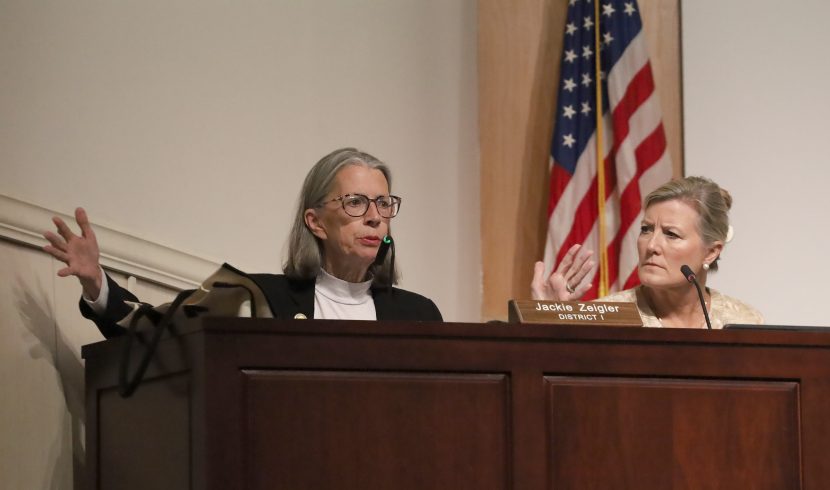
Board Vice President Marie Manning and members Tracie West, Tonya Chestnut and Yvette Richardson voted yes. Board President Pro Tem Kelly Mooney and members Jackie Zeigler, Allen Long and Wayne Reynolds voted no.
Board members who opposed adoption questioned the quality and historical balance of some textbooks, while supporters said schools needed vetted materials as they prepare to implement the new standards.
The vote had originally been scheduled for November but was delayed after some board members said they needed more information before deciding whether to adopt the list.
Several members of the public also addressed the board, with some urging adoption of the recommendations and others arguing the textbooks contained biased or incomplete historical information.
Alabama Eagle Forum Executive Director Becky Gerritson urged the board not to adopt the recommendations, citing examples she said presented incomplete or imbalanced portrayals of historical events.
“In a seventh grade text, Christianity’s spread is mainly linked through colonization and conquest, while Islam is described mostly through trade and cultural exchange,” she said. “Mohammed is described as honest and kind, and there is little mention of Islam’s military expansion or treatment of conquered peoples. This presents an incomplete and misleading view of history.”
Retired Baldwin County businessman Robert Monk, who leads the volunteer group called the Baldwin County Alabama Education Work Team, also criticized how some topics were portrayed in materials already used in elementary grades.
As one example, Monk objected to the way sharecropping was described.
“Following the Civil War, the landowners in the South had the land but no labor. The freed slaves had labor to offer but no land, and both were cash broke,” Monk said. “So the freed slaves provided the labor and the landowners provided the land for farming. Both parties got a shared profit, and this helped both parties survive, yet (the materials) simply presented it as whites taking advantage of former slaves without context.”
If the board had rejected the recommendations, local school boards would have had to select textbooks without guidance from the state textbook committee.
Two speakers urged the board to approve the recommendations.
Vestavia Hills Freshman Campus Principal Bill Mann said adopting the textbooks would support teachers and students as schools transition to the new standards.
Mann said educators serving on the textbook committee spent dozens of hours reviewing materials to determine which best aligned with Alabama’s standards and noted that early-career teachers especially rely on vetted instructional resources.
“Without standards-aligned materials, teachers are left to build lessons from whatever they can find online,” he said.
Homewood City Schools teacher Casey Piola, who served on the state social studies textbook committee, said the review process was led by Alabama educators and public appointees working to align materials with the state’s standards.
If the books were not approved, she said teachers would likely turn to outside sources with unknown agendas.
“Without these textbooks, we would be surrendering Alabama social studies instruction to third parties whose funding, motivation and values are completely unknown to us,” she said.
Speakers’ full remarks are available in the video of the meeting.
The committee submitted its recommendations to the board in October. The list includes both approved and rejected textbooks, posted on the Alabama Department of Education website, could not be made public until the board voted.
During a work session last month, board members spent much of the discussion debating whether the board should simply accept the textbook committee’s recommendations or take a more active role in shaping the list.
State Superintendent Eric Mackey said the board needed to act in March so school systems could begin selecting materials and ordering textbooks ahead of the August rollout of the new standards.
Mackey acknowledged that some textbooks were stronger than others but said schools will have several options to choose from at each grade level.
Local school boards may choose from any of the adopted textbooks. Districts can also adopt materials not on the approved list, as long as those materials were not specifically rejected by the board.
During a work session later in the day, Mackey said House lawmakers removed $7 million in funding that Ivey had proposed for the state to develop its own elementary social studies textbooks to give Alabama more control over the content.
Mackey said the idea may be revisited after the November election because developing textbooks would be a multi-year process, and officials would not want to begin the work only to stop midway under a new administration.
Mackey said school systems can begin purchasing materials once contracts with textbook publishers are finalized, which typically takes about six weeks.


Follow Us