WASHINGTON — From the start, the marquee race for Alabama’s open U.S. Senate seat has been partly defined by an unusually high number of undecided voters. It’s the one constant shown in poll after poll, with about 40% of likely Republican primary voters still unsure who they’ll back among six candidates vying to succeed Sen. Tommy Tuberville.
And yet with less than a week to go before the May 19 primary election, it will be those undecided voters who prove most decisive in determining who moves on to a likely runoff.
“Voters don’t have a reason to make a choice yet, and somebody has got to come out of the field at this point and explain why they should have the job,” Michael Lowry, founder of the Alabama Poll, told Alabama Daily News.
“They’ve got to make the case for why they are the person that should go to Washington to fight with President Trump for Alabama families. And I think that second piece is going to be key.”
For U.S. Rep. Barry Moore, much of his pitch for the seat relies on President Donald Trump’s endorsement of him.
“It’s just a matter of getting people to show up May 19, where, if you look at the numbers, we’ve got really, really high favorables, and the president…still (has) very high favorable(s) in Alabama,” Moore told ADN.
But this message has not led the three-term congressman from Enterprise to dominate the race. Recent polling shows him ahead of his two closest competitors, Alabama Attorney General Steve Marshall and former Navy SEAL Jared Hudson, but not by a significant margin.
Yet Moore is still projecting confidence.
“We’re ahead in the polls that we’re seeing, and so we feel good about our position,” Moore said.
And Trump isn’t the only heavyweight behind Moore’s bid. Cash-heavy political action committees are also backing the Senate hopeful, whose ads have swarmed the airwaves more than groups supporting Marshall and Hudson. He also has the support of Senate Majority Leader John Thune and National Republican Senatorial Committee Chair Tim Scott.
“To be blunt, he isn’t scoring,” Lowry told ADN. “That’s a lot of money going out for not any movement.”
But Moore continues to center his message on his political experience and Trump’s endorsement, which has been touted in numerous ads.
“For me, it’s just a matter of, ‘hey, we got a great record.’ We got relationships with the White House,” Moore told ADN. “We got relationships with people that can make a difference for Alabamians and their quality of life and economic development.”
In Alabama this year, Trump’s endorsement remains important for likely Republican primary voters but is not decisive. About 37% of voters said they would definitely vote for or strongly consider voting for the Trump-endorsed candidate.
“Endorsements and fundraising can be an important component in political campaigns,” Benjamin Gross, a political science professor at Jacksonville State University, told ADN. “It is not deterministic.”
That seems to be the case for this year’s primary, where Trump will have just two years left in his second term after the midterms. Plus, the president has a rocky track record on endorsements in the state.
Marshall entered the race as the clear favorite, mostly from having strong name recognition from nearly a decade of statewide service and the support of prominent groups, like the Alabama Farmers Federation. Yet Marshall’s opponents were able to chip away at that lead, leading him to trail Moore and Hudson in recent polls. Though Marshall has maintained a strong faction of support throughout the campaign season.
“I’ve shown the ability to be the voice and the advocate for the people that I’ve represented, and in doing so, we’ve not just simply talked about the issues, but in fact, we’ve delivered tangible results,” Marshall told ADN. “I’m going to do that in the United States Senate.”
He said his post as attorney general could help him gain traction with undecided voters who tune into the race at the last minute. He has made several national television appearances and gone viral online for his role in the recent situation with congressional maps and the Supreme Court.
“The value of being in my role is that people in Alabama know who I am, and they know what I’ve done,” Marshall said.
Hudson’s rise
Hudson, the political newcomer who was the first to launch his bid, has risen from relative obscurity to give both Moore and Marshall a run for their money in the final stretch.
Besides a failed campaign for Jefferson County sheriff, the anti-human trafficking nonprofit CEO hadn’t forayed into politics before his Senate run.
“The biggest thing that resonates with the people of Alabama is they’re sick and tired of folks that want to ride the coattails of other people,” Hudson told ADN.
That disruptor persona appears to be propping up Hudson’s surge, allowing him to contend with the more established Moore and Marshall.
“It’s time to stop electing career politicians and send regular people to Washington, but more importantly, real warriors to Washington, who, in our case, you can stand and fight on behalf of the state of Alabama, and that’s what I’m doing,” Hudson said.
He also has a large digital following, racking up more followers than the other two frontrunners on social media platforms.
“The voters who are saying, ‘Yeah, we’re not quite with Marshall, we’re not quite with Moore. What else is out there?’ Those are the folks that have gravitated towards Hudson,” Lowry told ADN.
“And if Hudson can spread his message and be out there in a consistent way, he’s got a real shot at making the runoff.”
Gross said his analysis of the primary also shows Hudson has an opportunity to break through enough to reach a likely runoff.
“Why is his campaign being successful? I think there’s definitely a level of messaging and framing the idea of being an outsider, I think (that) is helping him in that regard,” Gross told ADN.
Appealing to undecided voters
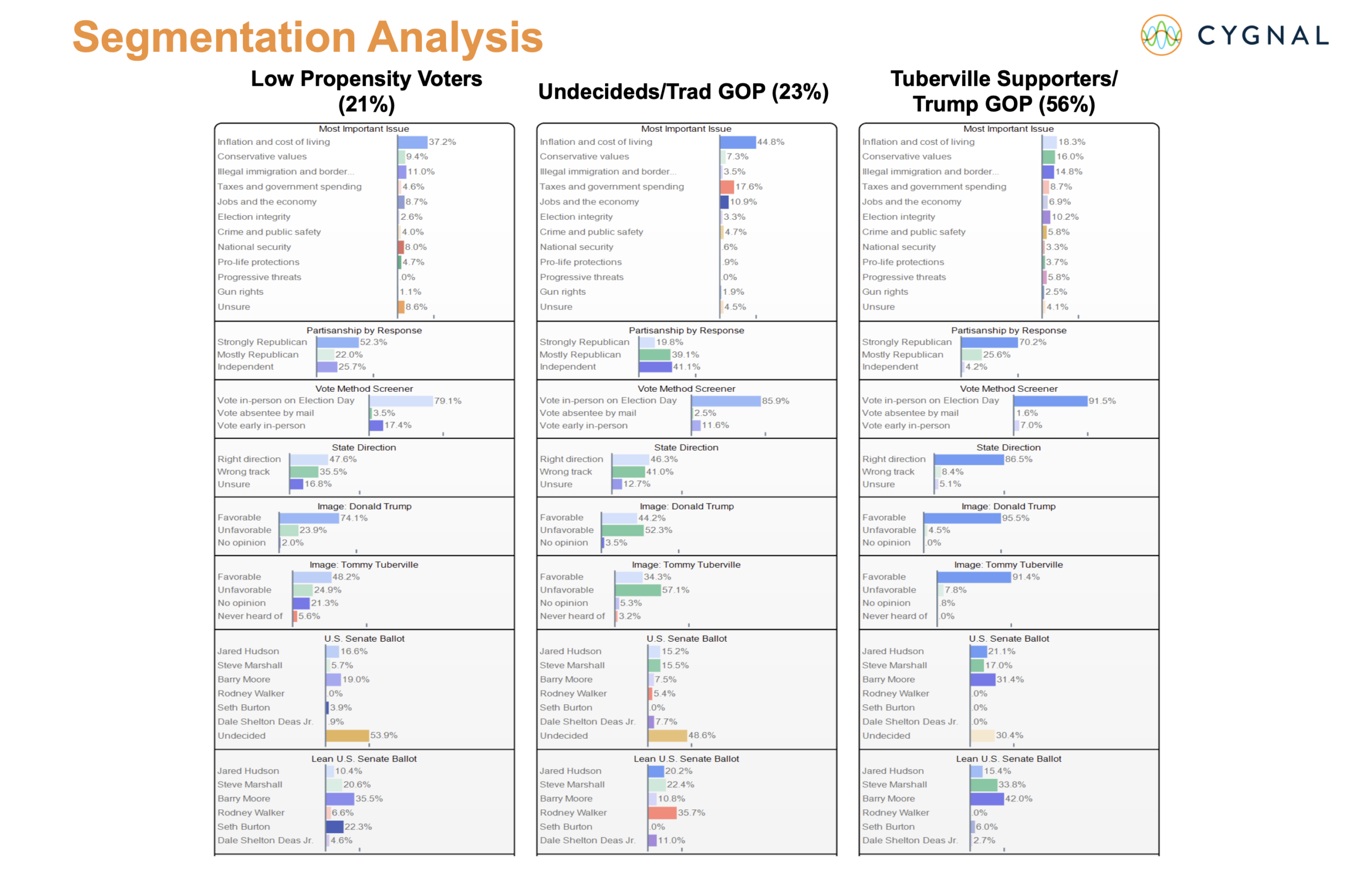
Moore appears to have a strong grip on the Trump Republican base in the state, which positions him as a formidable runoff opponent against Marshall or Moore. He’s also popular among low-propensity voters, though the challenge is getting them to the polls.
But Hudson and Marshall could appeal to other Republican primary voters who could prove decisive down the line.
The recent Cygnal poll commissioned by Alabama Daily News and Gray Television stations showed that the bloc of traditional Republicans and undecided of voters was almost evenly split between supporting Marshall and Hudson.
“I think both the Marshall and the Hudson campaign is hoping that if they can get into that runoff, that the other voters will jump from that campaign to their campaign, and that they can coalesce those voters together to form a coalition that would win in the runoff,” Gross told ADN.
Three other candidates are also vying for the Republican nomination in the U.S. Senate race, including Rodney Walker, Seth Burton and Dale Shelton Deas, Jr.
Those three men also received some support from the undecided voters in the recent statewide survey, but Gross said it’s unlikely that support transfers to the ballot box. Instead, it could translate to support for Hudson.
“My hunch is, if you’re willing to say Walker, or you’re willing to say Burton, you probably are more attracted to the idea of the outsider, and of those three main candidates, who’s the outsider, Hudson,” Gross told ADN.
Attacks against Hudson mount
A super PAC supporting Marshall’s bid appears to have taken notice of Hudson’s ascent, as the two candidates potentially jockey for the second spot in a runoff against Moore.
The American Values First PAC released a new ad, running in Birmingham and Huntsville, according to FCC records, attacking Hudson for his stance on the filibuster and the SAVE America Act, the GOP-led voter ID bill that’s stalled in the Senate. Previously, Moore and Marshall-aligned super PACs were attacking one another, not Hudson.
The new ad claims that “Hudson supports a rule allowing Democrats to block the SAVE America Act.” Hudson’s campaign pushed back on the ad, arguing it’s got “political insiders a little nervous” and emphasized his support of the elections legislation.
In an interview with ADN, Hudson said he doesn’t want to end the filibuster, arguing that it’s a “conservative tool” to encourage debate. But he does want to see some changes to the legislative procedure.
“I agree with ending the silent filibuster so somebody can’t just signal a filibuster and then go play golf and hold everything up,” Hudson said. “They need to stand on the floor. If you’re going to signal for a filibuster, you need to have to stand on the floor and earn the reason that you signaled it.”
But the irony is that Marshall has a similar view on the tactic that broadly requires 60 votes to end debate and pass legislation. The attorney general also has “not supported completely nuking the filibuster.”
“I would support changes that require minority party effort in order to engage in the filibuster itself,” Marshall told ADN, adding that he also wants to end the silent filibuster practice.
But Moore, like Trump, wants to get rid of it altogether.
“We have to,” Moore told ADN, adding that if Republicans don’t, Democrats will.
So, as Moore solidifies his base of Trump Republicans, Marshall and Hudson have the potential to capture Republican voters who might still support the president, but aren’t completely captivated by his policies. And those pickups could prove consequential.
The Republican nominee will face off against one of four Democratic candidates vying for the seat, Dakarai Larriett, Kyle Sweetser, Everett Wess and Mark Wheeler. If no candidate reaches a majority, a runoff will take place on June 16.
TAGGED:Washington | 2026 Alabama Primaries | Voting



Follow Us