
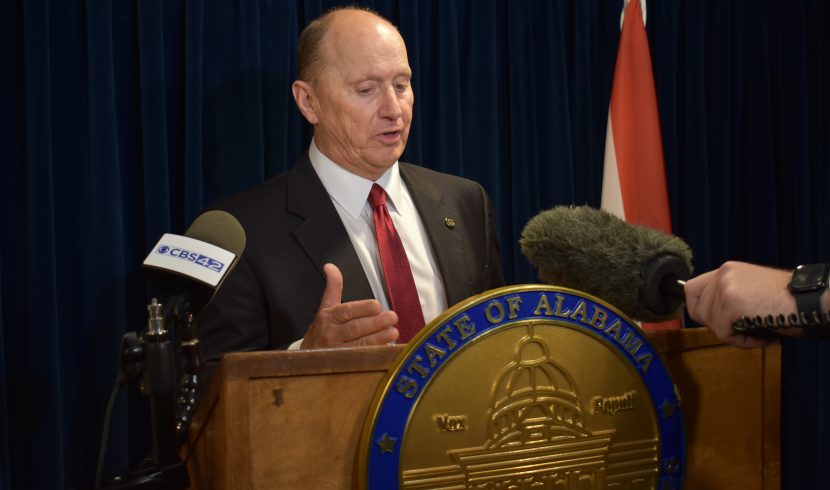
BIRMINGHAM, Ala. – The Alabama House on Tuesday approved a proposal that would place a constitutional amendment on the November ballot requiring public schools to allow voluntary student-led prayer and the Pledge of Allegiance at the start of the school day.
House members voted 94-3 to approve House Bill 511, sponsored by Rep. Reed Ingram, R-Pike Road.
If voters approve the amendment, public schools would be required to conduct the Pledge of Allegiance and provide an opportunity for a student to lead a voluntary prayer at the start of the school day.
Students would not be required to participate, and local school boards would adopt policies outlining how the prayer period would work.
The Pledge of Allegiance is already required to be recited at the beginning of each school day under a 2019 law. Students are also already allowed to pray in public schools under federal and state law as long as the prayer is student-initiated and participation is voluntary.
Earlier versions of the bill would have allowed the state to withhold up to 25% of state funding from school systems that failed to comply. Lawmakers removed that penalty from the House-passed version.
The House adopted amendments before final passage that also removed language allowing prayers to be broadcast over school intercom systems. The final version instead specifies that any prayer must be initiated and led by a student at the beginning of the school day.
“It’s on a volunteer basis – a student-led prayer,” Ingram said during debate.
Students would have the opportunity to stand after the pledge and offer a prayer if they choose, he said, with school systems setting limits on how long the prayer period could last.
“The school board has got to set a policy on what those parameters we’re going to give them,” Ingram said. “Thirty seconds, a minute, two minutes – that would be up to them.”
Ingram said he introduced the bill in part because of concerns about problems facing young people.
Supporters argued the legislation would restore practices that existed in schools before court rulings in the 1960s restricted organized prayer in public classrooms.
“Until 1962, prayer was as regular in school as anything else,” said Rep. Mark Gidley, R-Hokes Bluff.
“We’re invoking the very help that our founding fathers understood a nation could not exist without – that’s the hand of God. We’re not trying to indoctrinate anybody or put anybody under pressure – only return back what was taken away that was precedent for almost 200 years,” he added.
But several Democrats raised concerns about whether the proposal could make some students feel excluded or expose school systems to legal challenges.
Rep. Laura Hall, D-Huntsville, said many students come to school with needs that cannot be addressed simply through prayer.
“Many times those students that come into that classroom have a need,” she said, pointing to issues such as hunger and mental health. “Prayer may be one of them but there are other needs that they have.”
Rep. Marilyn Lands, D-Huntsville, said she worried students of minority faiths could feel singled out.
“I’m just afraid that any child might be put in a position where he feels unwelcome or she feels unwelcome,” Lands said.
Some lawmakers also questioned how the law would work in practice if students chose not to participate but remained in the classroom.
Rep. Mary Moore, D-Birmingham, said she worried it could lead to conflict if students objected to hearing prayers in class.
Ingram said students would be able to leave the classroom if they didn’t want to participate. Moore said that might not solve the problem.
“I want to be in the room, but I just don’t want to have somebody praying over me,” Moore said.
The proposal, which still needs approval in the Senate, would amend the Alabama Constitution and must be approved by voters statewide if it passes the Legislature.
House Speaker Nathaniel Ledbetter, R-Rainsville, said the measure would allow voters to decide whether prayer should return to Alabama classrooms.
“We should be teaching our children to take pride in being American and to boldly share their faith,” Ledbetter said in a statement after House passage.


Follow Us