
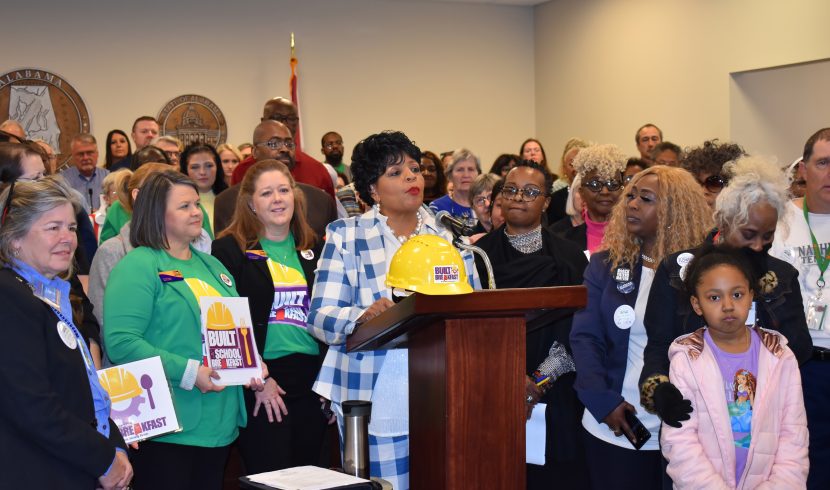
BIRMINGHAM, Ala. – With education budget talks set to begin as early as next week, advocates are urging Alabama lawmakers to add $14 million to the state’s proposed $10.5 billion education spending plan to cover a gap between federal school breakfast reimbursements and the actual cost of serving meals.
The request, highlighted Tuesday at a State House news conference organized by Alabama Arise, would allow every public school in the state to offer breakfast at no cost to students without operating the program at a loss.
Advocates argue that offering school breakfast at no cost improves academic outcomes.
“When breakfast is offered at no charge for students, participation increases, attendance improves, nurses report fewer morning stomachaches and headaches,” Alabama School Nutrition Association President Cacyce Davis said.
“Teachers see better focus and behavior in the classroom, families experience meaningful financial relief and academic outcomes improve.”
Rep. Barbara Drummond, D-Mobile, echoed that sentiment.
“I know that a healthy breakfast is the first lesson of the day,” Drummond said. “When children eat well in the morning, they learn better all day.”
Lawmakers allocated $7.3 million in supplemental funding this year to help districts cover the difference between federal reimbursements and the full cost of preparing and serving breakfast.
“The (federal) reimbursement rates do not cover the full cost of our meals and operating our programs,” Davis told Alabama Daily News. A typical school breakfast includes a breakfast entree, which could be cereal or a sausage biscuit, a choice of fruits and a carton of milk, Davis said.
Food and labor costs are “out of control,” Davis said, adding that expenses vary by district depending on local food availability.
In the contiguous states, federal reimbursement rates for breakfast are $2.46 for students eligible for free meals, $2.16 for reduced-price meals and 40 cents for students classified as paid.
Schools designated as “severe need” receive roughly 50 cents more for free and reduced-price categories. The U.S. Department of Agriculture sets the rates annually.
Reimbursements cover only part of the expense. Schools must also pay for labor, equipment and overhead, and whether to offer universal no-cost breakfast often comes down to whether the program can at least break even.
Participation in the federal Community Eligibility Provision, which allows high-poverty schools to serve breakfast and lunch at no charge to all students, has more than doubled in Alabama over the past five years.
This school year, about 1,100 of Alabama’s 1,370 schools participate in the program, serving roughly 548,000 of the state’s 720,000 students. In 2018-19, about 400 schools and 205,000 students participated.
Another 170 schools were eligible this year but chose not to participate, while roughly 80 schools do not meet eligibility requirements.
Federal rules allow schools to qualify for the Community Eligibility Provision if at least 25% of students are directly certified as participants in federal aid such as Medicaid, the Supplemental Nutrition Assistance Program or Temporary Assistance for Needy Families. Students from households earning 130% of the federal poverty level qualify for free meals, while those at 185% qualify for reduced-price meals.
Lawmakers are expected to begin debating Gov. Kay Ivey’s proposed $10.5 billion education budget and a $420 million supplemental spending plan in the coming days.
Davis, who has served as Child Nutrition Program Director in Elmore County for the past decade, said she hopes lawmakers view the request as a long-term investment rather than a line-item expense.
“Healthy school meals at no cost for all students are not an expense,” Davis said. “They are an investment. They’re an investment in families, in communities and in the future workforce of our state.”


Follow Us