
BIRMINGHAM, Ala. – Alabama lawmakers heard from the state’s education officials about their budget priorities for the 2027 fiscal year during a joint legislative meeting Monday in Montgomery.
The hearings give legislators an early look at agency needs before they start making spending decisions for fiscal year 2027, which starts Oct. 1. With Education Trust Fund receipts down 2.3% for the current fiscal year, lawmakers are facing tighter revenue at the same time that major education costs continue to rise.
Pressure is also building in the state’s General Fund, which supports non-education agencies. General Fund revenue is expected to decline by 4.2%, and Ivey has proposed level funding for all state agencies.
The education budget covers pre-K, K-12 and higher education along with education-related agencies and functions. Gov. Kay Ivey has proposed a record $10.5 billion education budget, but lawmakers are expected to make changes to that plan as well as to a separate $420 million allocation of surplus 2025 tax revenue, known as the supplemental budget.
Throughout the hearing, lawmakers’ questions focused on long-term costs and the sustainability of major education programs, particularly as health care and other expenses continue to rise.
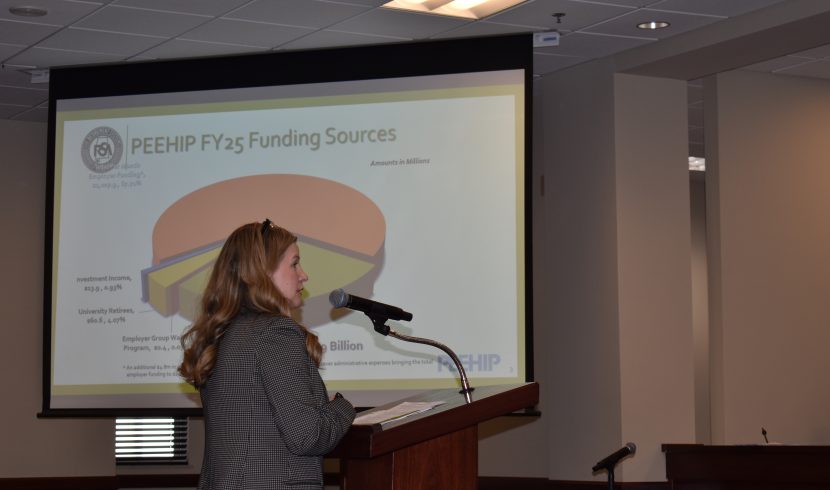
A large portion of the discussion centered on the Public Education Employees’ Health Insurance Plan, or PEEHIP, which provides coverage for 355,000 public education employees, retirees and their dependents.
Neah Scott, legislative counsel for the Retirement Systems of Alabama, told lawmakers health care costs continue to increase across the system. The plan is facing a $380 million shortfall for the 2027 fiscal year, according to current projections.
Ivey’s proposal includes funding $152 million of that gap, but that leaves program administrators with limited choices for how to make up for the remaining costs.
Garrett pointed to the growing gap between rising costs and employee contributions.
“Premiums haven’t been increased since 2016,” Garrett said.
Scott said rising costs are largely driven by factors outside the state’s control, including hospital pricing and increased use of medical services.
“We don’t control how often people go to the hospital or how much providers charge,” she said.
Education officials then outlined other areas where funding needs are outpacing available resources.
Jimmy Baker, chancellor of the Alabama Community College System, told lawmakers that years of deferred maintenance have left many campuses struggling to keep facilities up to date, even as demand for workforce training grows.
Baker said the system is working toward creating a dedicated deferred maintenance fund to address long-standing infrastructure needs across the state’s 24 community colleges and 130 campuses.
“I think that can happen and will make a big difference in the maintenance,” Baker said.
Jim Purcell, executive director of the Alabama Commission of Higher Education, said public universities face financial pressure because state funding covers only a small share of the cost of educating in-state students. As a result, institutions increasingly rely on out-of-state students who pay higher tuition.
Garrett and Senate Education Budget Chairman Arthur Orr, R-Decatur, have said they want higher education funding to be at least partially tied to outcomes, though no bill has been filed and funding amounts have not been determined.
State Superintendent Eric Mackey told lawmakers that K-12 education faces cost pressures of its own, particularly as the state works to remain competitive with neighboring states when it comes to salaries.
Mackey said personnel costs dominate the K-12 budget.
“We’re people-intensive,” he said. “About 85% of our budget goes to pay for people.”
Teachers did not receive a raise for the current school year, but Ivey has proposed a 2% pay raise for 2027.
Mackey also pointed to rising transportation costs, telling lawmakers the price of school buses has roughly doubled over the past decade. Ivey proposed increased funding for school buses as part of the state’s Foundation Program, and put a $67 million allocation specifically for purchasing new buses as part of the supplemental.
Mackey urged lawmakers to continue investing in early literacy and math initiatives, including the “Struggling Readers Beyond Grade 3” program. Lawmakers initially funded the program at $5 million two years ago, increased it to $17 million in last year’s supplemental budget, and the governor has requested $45 million for the program in the upcoming supplemental.


Follow Us