

BIRMINGHAM, Ala. – The deadline for Alabama’s much-touted goal of credentialing 500,000 people to bolster its workforce base has come with little fanfare. Yet one estimate shows the state has come within just 12,000 of that lofty goal despite significant headwinds.
The objective, announced by Gov. Kay Ivey in April 2018 as part of the state’s Success Plus initiative, officially expired April 30, a date that appears only in Alabama’s federal workforce plan under the Workforce Innovation and Opportunity Act.
Outside of that document, there was no public marker, announcement or acknowledgment that the deadline had arrived — and the goal was nearly reached — or what’s next.
Another goal of the initiative — raising the percentage of Alabamians in the workforce, was not met. But Ivey’s original effort has been picked up by the Alabama Legislature, which has made workforce issues a top priority in recent years.
Success Plus set out to add 500,000 newly credentialed workers to Alabama’s labor force by 2025, a benchmark tied to the Lumina Foundation’s then-national goal that 60% of working-age adults hold a postsecondary credential or degree.
Reaching that target, focused on people aged 16 to 64, would have required the state to produce an average of about 62,500 new degrees or credentials per year over the initiative’s eight-year span.
According to a newly released update from the Alabama Commission on Higher Education, Alabama came close, but did not fully reach the goal.
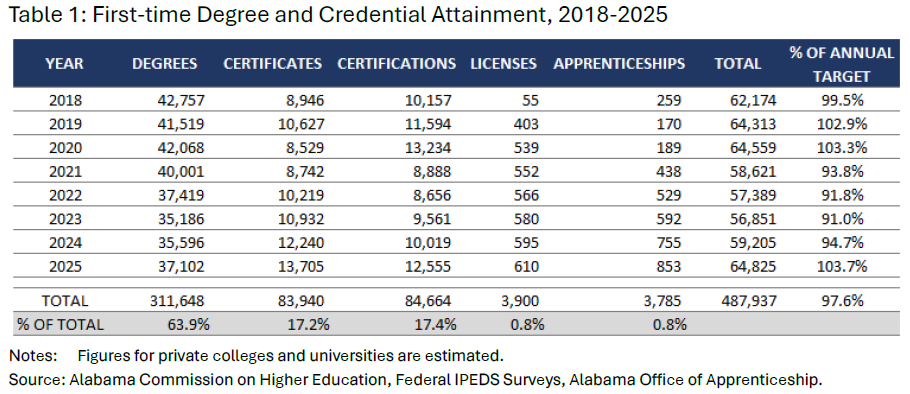
From 2018 through 2025, an estimated 487,937 Alabamians earned a first-time postsecondary degree or credential, about 12,000 short of the 500,000 target, or roughly 97.6% of the goal.
The chart below, from the ACHE report, breaks down each category of new credentials there were attained: Degrees include associate’s and baccalaureate degrees, certificates (academic and occupational certificates), certifications (industry and occupational certifications), professional licenses and registered apprenticeships.
Headwinds
When Ivey set that ambitious Success Plus credentialing goal in 2018, no one knew that a global pandemic was less than two years away. COVID-19 sent the very agencies responsible for this work into emergency mode, with demands for unemployment benefits climbing to historic highs.
The ACHE report acknowledged that the COVID-19 pandemic, which struck at the midpoint of the initiative, had a significant impact on degree and credential attainment.
“The pandemic significantly disrupted college enrollment, student persistence, credential completion and workforce participation across the state, creating unfavorable conditions for college attainment,” the report states.
Alabama would also go on to completely overhaul its labor and workforce apparatus. During the 2024 session, the Alabama Legislature, led by Ivey, passed a package of bills known as “Working for Alabama,” part of which consolidated multiple state agencies into one Department of Workforce. That consolidation work is still ongoing.
And Nick Moore, who spearheaded the Success Plus project as director of the Governor’s Office of Education and Workforce Transformation, early this year left the state to take a position with the Trump administration. He is now assistant secretary for the Office of Career, Technical and Adult Training at the U.S. Department of Education.
ACHE Executive Director Jim Purcell described the original benchmark as intentionally ambitious and said the coming this close despite significant challenges is “impressive.”
“The 500,000 credential was a stretch goal,” he said. “The fact that we were as close as we are is impressive. Governor Ivey and her staff’s efforts and the legislative support for this initiative in both legislation and funding made the success of this initiative possible.”
Asked this week about the 500,000-credential goal, Ivey emphasized progress and future efforts.
“Alabama continues attracting new, highly paid jobs that require a well-equipped workforce,” Ivey said. “We have been deliberate in our efforts to increase our credentialed workers in our state, and those efforts are paying off for us. Alabamians are not only prepared for the jobs of today; we are preparing for the jobs of tomorrow. I am proud of our progress, but we will keep pressing on to skill-up and increase our labor force participation rate.”
By the numbers
ACHE’s figures draw on data from public colleges and universities, federal IPEDS surveys for private institutions and apprenticeship and certification data from the Alabama Office of Apprenticeship and Alabama Industrial Development Training agency.
ACHE cautioned that the figures are estimates and do not reflect a comprehensive audit. Still, the update represents the most complete public accounting to date of where the state landed as 2025 comes to an end.
Purcell said the commission undertook the update on its own initiative, not at the request of the governor’s office or lawmakers.
“ACHE reached out to our partners on the initiative and updated the results,” Purcell said. “Much of the data was readily available to ACHE as many of the strategies for the ACHE Strategic Plan involved increasing credentials that support the economy and therefore we were already tracking much of the data.”
ACHE’s strategic plan closely aligns with the goals of Success Plus, positioning the agency to compile the update using data it was already tracking, even as few others were willing to discuss the initiative’s outcome on the record.
Beyond the numbers, ACHE’s update emphasizes structural changes that outlast the Success Plus initiative.
“This strengthened alignment between higher education and workforce development remains as one of the initiative’s most enduring outcomes,” Purcell said.
Under the Success Plus umbrella, the state also developed new data tools designed to help students and job-seekers connect credentials to high-demand careers.
The Alabama Talent Triad has been heralded as an innovation with the potential to have a broad impact on students and job-seekers. The website includes the Alabama Credential Registry, Alabama Compendium of Valuable Credentials – a subset of credentials needed for high-demand jobs – and a list of available apprenticeships by city.
Labor participation rate largely unchanged
Beyond credential attainment, Success Plus had another visible goal: Raising Alabama’s labor force participation rate above the national average. That target was not met.
Alabama’s labor force participation rate stood at 57.3% when the initiative was announced in April 2018 and remains at 57.3% as of August 2025, according to the latest available data.
While the rate rose during the eight-year span, it also fell, particularly during the pandemic, and never surpassed the national level. The graph below, from the Federal Reserve Bank of St. Louis, depicts Alabama’s rate during that period of time. Click here if you are unable to see the graph.
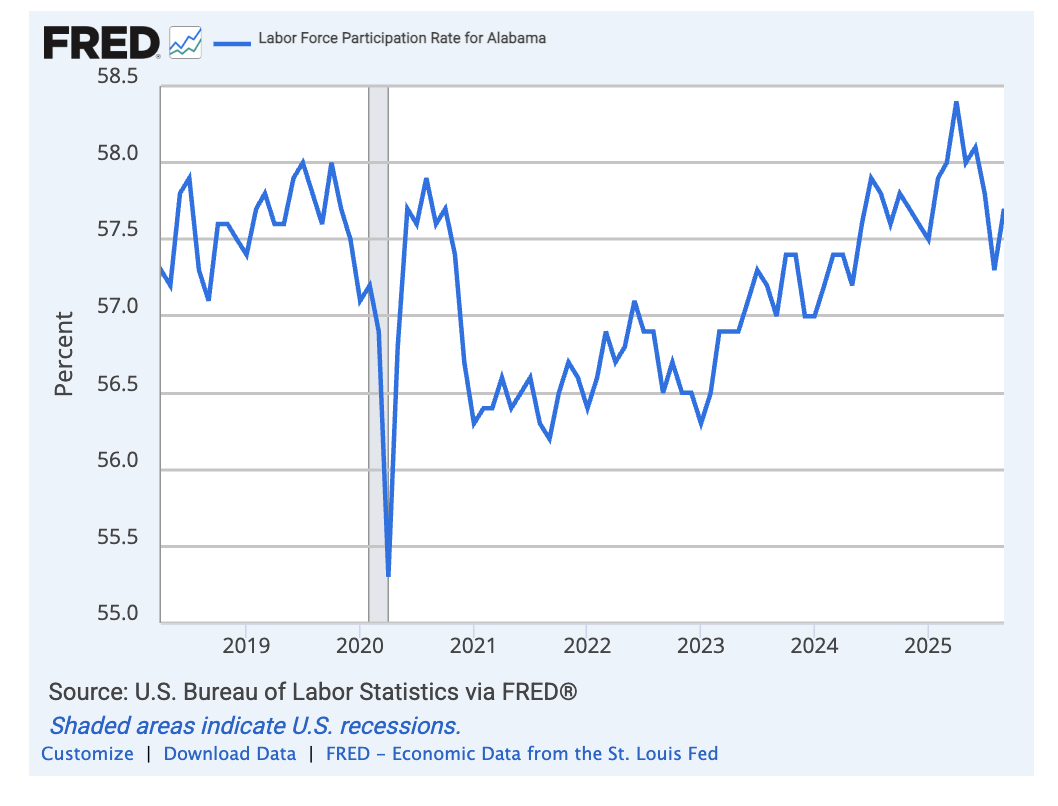
The numbers show a challenge identified in the ACHE report: Increasing credential production alone does not automatically translate into higher workforce participation, particularly among working-age adults facing barriers such as childcare, transportation, broadband access or the need to balance education with employment.
Looking ahead, ACHE frames Success Plus not as a completed project but as groundwork for what comes next.
“Based on the results of the Success Plus Initiative and the state’s progress toward the 500,000 credential goal, Success Plus should be viewed not as a finite sprint, but as the foundation for a sustained and permanent workforce-attainment system,” Purcell said.
The emphasis on continuity is echoed in ACHE’s report.
“Maintaining momentum is more consequential than reaching an exact benchmark, particularly to prevent credential production from plateauing as the visibility of a major initiative diminishes,” the report states.
The update points to Lumina’s current national benchmark – calling for 75% of adults to hold a valuable degree or credential by 2040 – and urges Alabama officials to focus less on volume and more on credentials that deliver long-term economic gains.
Whether the state will formally reset its attainment goals or continue without a target remains unclear, even as much of the infrastructure built under Success Plus continues to operate.


Follow Us