
BIRMINGHAM, Ala. – Lawmakers approved the CHOOSE Act last year because they said parents want more choices in where their children go to school. A first look at the private schools signed up for the program shows those choices are plentiful in some areas but scarce in others.
That’s expected and common, advocates say.
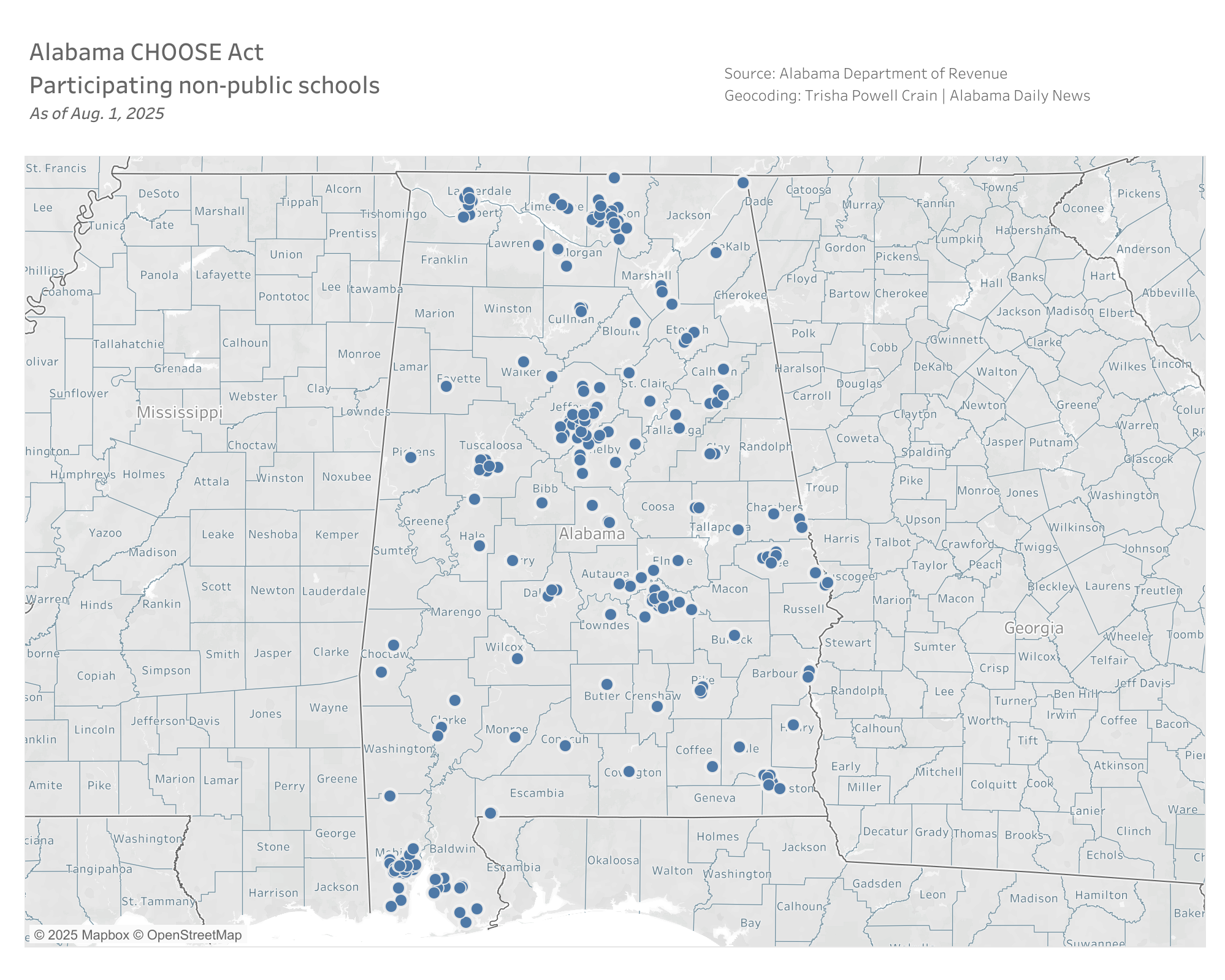
A new map shows the location of almost every private school currently participating. Out of 246 schools, just one couldn’t be mapped because it does not publish a physical address for safety reasons. The map offers a visual snapshot of where the program is starting and where gaps exist.
The largest concentrations of participating schools are in Birmingham, Montgomery, Mobile and Huntsville. For families in those areas, participating schools could be within a short drive. Additional clusters of participating schools appear in Tuscaloosa, the Shoals area of northwest Alabama, Dothan in the Wiregrass region and southern Baldwin County.
Outside of those areas, the map looks different. Fourteen counties, most along the state’s eastern and western borders, don’t have a participating school. Another 19 counties have one. For families in these places, using the program could mean driving an hour or more each way – a challenge for those without reliable transportation or flexible work schedules. Alabama does not regulate or license private schools, so there is no official count of how many private schools there are statewide. That means it’s unclear what percentage of the state’s existing private schools are participating.
While most participating schools are private, two public school systems – Dothan City schools and Mobile County public schools – are participating. Under the law, students from outside those public districts can use an ESA to enroll there.
House Education Budget Danny Garrett said he isn’t surprised that there are places where participating private schools are few.
“Some private schools probably like the size they are and don’t want to grow,” he said.
Another reason a school might not choose to participate is because participation means providing data to state officials, he added.
EdChoice policy director Nathan Sanders echoed Garrett’s remarks, telling Alabama Daily News that private schools also tend to be located where the population can support them, typically in urban or suburban areas.
“If you have a rural district there’s not a ton of kids in terms of your student population,” Sanders said. “Maybe there isn’t a big enough demand for someone to come in and open a private Christian or other type of school.” But he noted that CHOOSE Act ESAs can also be used for virtual or homeschooling, giving families without a nearby private school another way to participate.
He added that it’s common for new school choice programs to grow gradually as both families and education providers see how the system works.
“If you look at a place like Florida, which has had some form of school choice for more than 20 years, the education market is now incredibly diverse,” he said. “I’d be shocked if (Alabama’s) map looks the same three years from now.”
Sanders said the 37,000 applications for Alabama ESAs submitted this year show there is strong demand for the program, even if participation rates among private and public school students are still relatively small in year one. He expects more schools to join as the program matures and more families apply.
Sanders said that in the first year of a new program, about 20% of eligible private school students and around 3% of eligible public school students statewide would be expected to use an ESA.
“You’re not going to have every single education entrepreneur and private school leader jump into that market year one,” he said. “Some of them like to wait for different reasons.”
The CHOOSE Act, approved by lawmakers in 2024, creates education savings accounts funded by the state that parents can use for a range of educational expenses. That can include tuition, fees, textbooks and a curriculum for homeschooling students, along with educational services.
The amount of the ESA varies by the type of education a student pursues:
- $7,000 ESAs for eligible students in private or participating public schools
- $2,000 ESAs for homeschoolers, up to $4,000 per family
For its first two years, the program is limited to families earning less than 300% of the federal poverty level – about $95,000 for a family of four. The law states that all families will be eligible beginning in 2027–28, but that will depend on how much money lawmakers make available.
Though lawmakers allocated up to $180 million for this first year’s ESAs, it doesn’t appear that much will be needed. According to the Alabama Department of Revenue, which administers the program, as of July 7, the state had awarded 23,429 ESAs totaling nearly $128 million:
- 14,587 for private school tuition – $7,000 each
- 1,442 for public school enrollment – $7,000 each (only for students from outside the district)
- 7,208 for homeschooling – $2,000 per student, up to $4,000 per family
- 192 for “other school” expenses – likely $7,000 each
The current list of participating schools could grow, as state officials have said schools can join the program at any time during the year. ADN will update the map periodically as changes are made.
Each dot on the map represents a participating private school. Zoom in for a clearer look at areas with many schools. Hover over a dot to see the name of the school and enrollment capacity.
Click here to view the interactive map.

Follow Us