
BIRMINGHAM, Ala. — Alabama’s college-going rate is slowly recovering after declining sharply during the pandemic, but a new data analysis suggests the path from high school to higher education is changing in ways that traditional measures don’t fully capture.
A growing number of Alabama students are taking college courses before they graduate, which complicates how first-time college enrollment is counted and is reshaping what student bodies look like at both two- and four-year institutions.
The findings come from a new report by the Public Affairs Research Council of Alabama, which analyzed college-going patterns for Alabama’s public high school graduates, including the class of 2024, using data from the Alabama Commission on Higher Education and the National Student Clearinghouse.
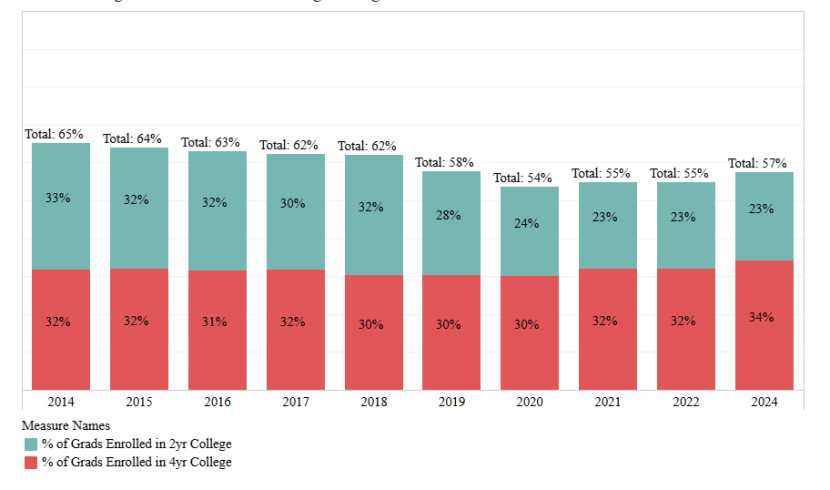
Overall, the college-going rate ticked up again last year – from 55% to 57% – but still hasn’t returned to pre-2020 levels. It was 65% a decade ago. And the split between two- and four-year colleges is shifting.
Four-year colleges enrolled a record share of Alabama graduates in 2024, reaching the highest percentage in recent years at 34%. Meanwhile, the share of students heading to two-year colleges the year after high school – currently at 23% – remains well below the 33% it was a decade ago.
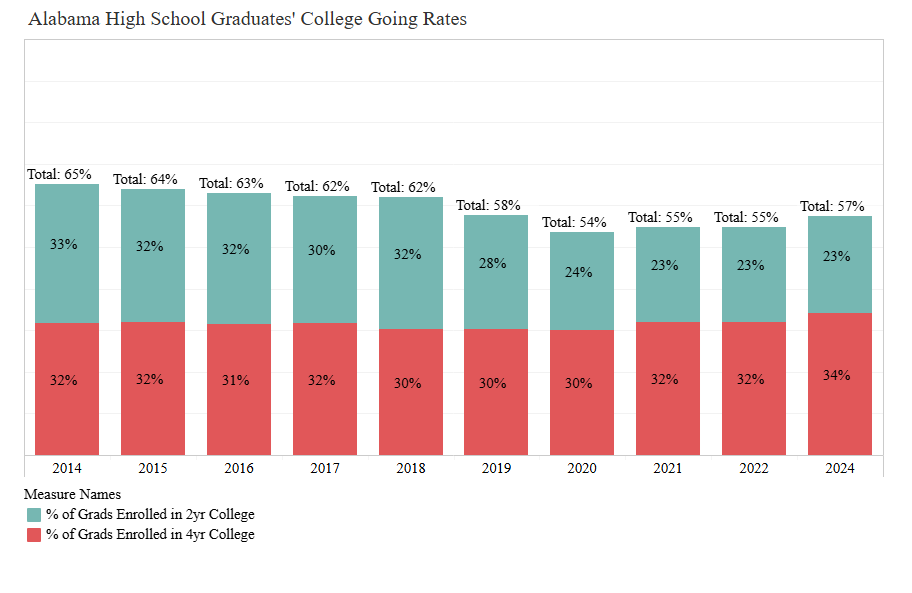
PARCA report, November 2025.
Patterns of college-going differ across the state. Wealthier systems continued to send large majorities of graduates to four-year campuses – Mountain Brook, for example, sent 93% of 2024 graduates – while other districts saw more mixed pathways.
PARCA has created an interactive dashboard where readers can explore trends for individual schools and districts.
The report suggests several reasons why fewer students may be enrolling in two-year colleges right after high school. One major factor is the rapid growth of dual enrollment – where high school students take college courses for credit.
Dual enrollment has expanded quickly in Alabama, and PARCA notes that this may be reducing the number of students who show up in the data as enrolling in college the year after high school, even though more students are earning college credit earlier.
In practical terms, some students who might have started at a two-year college full-time after graduation are now accumulating a meaningful number of college credits while still in high school.
After graduating high school, they may take a break before enrolling full-time, go straight into the workforce or transfer into a four-year university with community college credit. All of these choices make first-year enrollment at two-year colleges look lower.
For community colleges, this has mixed effects. Dual-enrollment partnerships give high school students a head start, save families money, and better prepare students for college-level work. But they also mean fewer students show up as first-time freshmen in the fall, since so many have already taken those courses.
Labor market conditions could also be playing a role, PARCA noted. Alabama’s unemployment rate has been below 4%, and earning a wage might make full-time work appealing for recent graduates.
PARCA notes that because of this shift, some traditional measures – especially the rate of students going straight into college after graduating high school – no longer tell the whole story.


Follow Us